
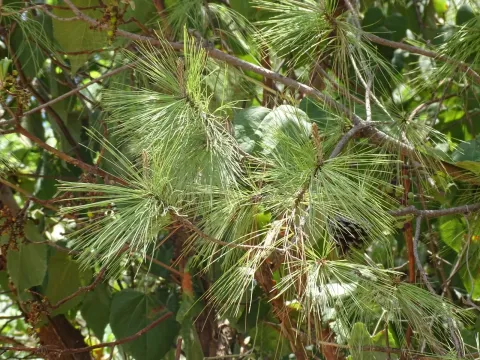
Teocote pine
Pinus teocote
Sowing of Teocote pine seeds usually takes place in the spring, once soil temperatures reach a stable range of 10–12 degrees Celsius. Seed stratification is recommended to improve germination rates in nurseries.
What the section contains
Teocote pine
In their natural environment, these trees propagate naturally after cones open during the dry season. For reforestation, seeds should be sown in well-prepared, high-drainage substrates.
The planting depth is crucial, ideally ranging from 1 to 2 centimeters to ensure the seed has enough energy to sprout while maintaining access to sufficient moisture.
Using seedlings with a plug root system is highly effective for increasing survival rates when planting in permanent forest locations.
Depending on the specific forestry goal, planting density usually ranges from 1,500 to 2,500 trees per hectare to ensure optimal timber development.
Teocote pine, a member of the Pinaceae family, is endemic to the high-altitude mountain regions of Mexico and Guatemala, preferring a temperate climate with seasonal rainfall.
The species is highly shade-intolerant, meaning it requires full exposure to sunlight to thrive and reach its full growth potential without stunting.
While the tree is quite resilient and can grow in rocky or nutrient-poor soils, it prefers deep, well-drained, and slightly acidic soil profiles for best performance.
The species possesses moderate cold tolerance, which allows it to be grown in specific high-elevation areas outside its native distribution range.
Proper water management is essential; avoiding waterlogging is critical to preventing root rot and ensuring the long-term health of the pine stand.
The yield of Teocote pine is determined by the age of the harvest and the intensity of silvicultural management, with high-quality timber produced over a 30–40 year cycle.
Productivity is measured by the volume of commercial-grade timber obtained through standardized forest management practices and thinning operations.
Beyond timber, the species is historically utilized for resin extraction, providing a sustainable economic secondary product through careful tapping methods.
Seed production and cone yield vary significantly based on climatic fluctuations, particularly the impact of rainfall patterns on flowering and seed development.
The growth rate is fastest during the first 20 years of the tree's life, after which the wood density and overall quality continue to improve significantly.
Bark beetles represent one of the most severe threats, as they tunnel under the bark and destroy the tree's vascular system, leading to rapid decline and death.
Fungal pathogens such as needle cast can trigger premature needle drop, which significantly weakens the tree and hampers its photosynthetic capabilities.
Defoliating insects, including sawfly larvae, pose a persistent threat by consuming needles, which can leave the tree vulnerable to secondary infections if left untreated.
Maintaining forest health requires regular sanitation logging and careful monitoring to keep tree density at levels that allow for adequate airflow and disease prevention.
- Regular forest health assessments.
- Application of biological pest controls.
- Removal of infected and deadwood.