
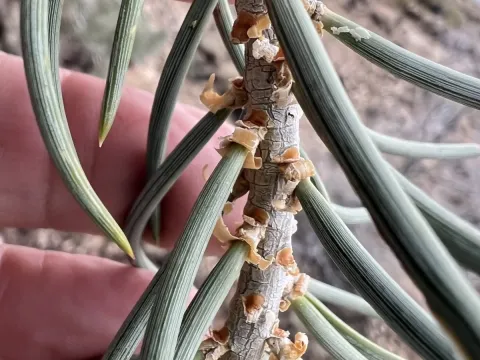
Single-leaf pinyon
Pinus monophylla
Propagation of Pinus monophylla is primarily achieved through seeds, which require a cold stratification period of 30 to 60 days to break dormancy.
What the section contains
Single-leaf pinyon
In nature, seed dispersal is facilitated by birds, particularly pinyon jays, which cache seeds in the ground and inadvertently aid in forest regeneration.
For nursery cultivation, seeds should be sown in a well-draining, gritty soil mix at a depth of approximately 2 to 3 centimeters.
Sowing is best performed in late autumn, allowing the seeds to undergo natural winter stratification before germinating in the early spring.
Seedlings develop a robust taproot early on, making them highly sensitive to transplanting; therefore, container-grown plants are preferred for forest establishment.
The single-leaf pinyon is a slow-growing evergreen tree belonging to the Pinaceae family, native to the arid mountains of the southwestern United States.
It is exceptionally adapted to semi-arid climates, thriving in rocky, alkaline, or sandy soils where moisture retention is minimal.
The species demonstrates remarkable resilience to extreme temperature fluctuations, growing in elevations ranging from 1,000 to 2,500 meters.
Full sun exposure is critical for the tree's health; partial shade can lead to sparse foliage and increased susceptibility to fungal issues.
Water requirements are very low once the tree is established, as its deep root system allows it to exploit subterranean water sources.
The primary economic value of the single-leaf pinyon lies in the production of edible pine nuts, which are highly prized for their flavor and nutritional profile.
Yields are highly cyclical and dependent on climatic variables, with bumper crops occurring periodically every few years.
The tree enters the productive reproductive stage only after reaching significant maturity, often requiring 15 to 25 years before yielding harvestable quantities.
Pine nuts are rich in unsaturated fats, proteins, and vitamins, serving as a traditional food source for indigenous populations and a gourmet commodity.
Beyond nut production, the tree is utilized for erosion control and as a drought-tolerant ornamental species in xeriscaping projects.
The species faces pressure from bark beetles, which can cause significant mortality during prolonged periods of drought and environmental stress.
Fungal diseases like pinyon blister rust can impact the health of the trees, particularly in areas with stagnant air and excessive moisture levels.
Invasive grasses and changing fire regimes represent significant threats to young pinyon populations by altering the natural landscape dynamics.
Management practices focus on thinning dense stands to improve resource availability and reduce competition for limited soil moisture.
Monitoring for signs of infestation, such as sap flow or boring holes, is essential for maintaining the health of pinyon woodlands.
The harvesting of pinyon nuts is typically conducted during the autumn months when the cones turn from green to brown and begin to open.
Traditional gathering involves collecting the cones before they fully open to prevent the loss of the seeds to animals or the forest floor.
Cones are spread in a sunny, dry area or placed in a drying shed until the scales fully retract, releasing the individual pine nuts.
Once released, the seeds are cleaned by winnowing or manual sorting to remove shell fragments and empty husks.
Proper storage is vital; the seeds should be kept in a cool, dry, and dark environment to maintain oil quality and prevent rancidity.