
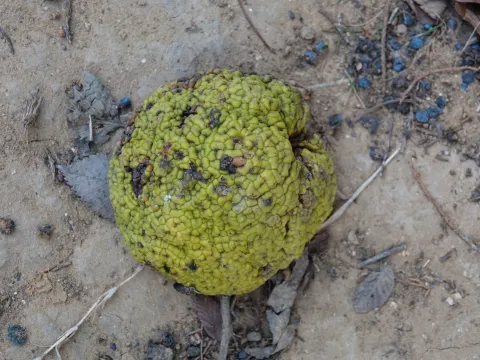
Osage orange
Maclura
The propagation of Maclura pomifera is typically performed through seeds, which require a stratification process lasting about two months at cool temperatures to ensure successful germination.
What the section contains


Osage orange
Seeds should be sown in early spring in well-prepared, loose soil, placed at a depth of approximately 2–3 centimeters to encourage steady sprout development.
Vegetative propagation via root cuttings is also possible and is often preferred in commercial nurseries to maintain consistent traits of specific parent trees.
Young seedlings require attentive care, including regular irrigation and weed control, as their initial growth phase is relatively slow and sensitive to competition.
Once the saplings reach two or three years of age, they are generally hardy enough to be transplanted into their permanent locations in open fields or orchards.
As a member of the Moraceae family, Maclura pomifera is highly valued for its adaptability, thriving in various soil conditions including rocky or saline areas.
The tree prefers deep, fertile, and well-drained soils, but it is extremely intolerant of stagnant water and poorly drained sites, which can lead to root failure.
Climate adaptability is a key feature, as the tree is drought-tolerant; however, it prefers regions with long, warm summers to ensure proper fruit maturation.
Sunlight is essential for the health of the tree, which is why it should be planted in open areas where the canopy can spread without the threat of shading.
The tree develops a massive root system, making it an excellent candidate for windbreaks and erosion control in arid or semi-arid agricultural landscapes.
The primary economic output of the Osage orange includes its incredibly dense, rot-resistant wood and its unique fruit, which is rich in chemical compounds.
Fruit production usually begins after a decade or more of growth, making it a long-term investment for landowners who prioritize forest products or sustainable wood supplies.
The timber is highly prized in carpentry for its durability, often used to create specialized items like tool handles, fence posts, and premium furniture.
Although the fruit is non-edible for humans, it is processed for its extracts, which are utilized in various industries for their antimicrobial and repellent properties.
Integrated agricultural systems often use the tree as a perimeter fence, providing natural protection for livestock while stabilizing the soil around the farm boundary.
Maclura pomifera is notably resilient, showing high natural resistance to most common pests that afflict other broadleaf fruit and hardwood trees.
Fungal infections are rarely observed unless the tree is subjected to excessive moisture, which can compromise the root system's integrity during cold spells.
Rodents pose the most significant risk to young plants, as they may gnaw on the bark during winter, potentially girdling the stem and causing the tree to perish.
Poor site selection, such as planting in low-lying areas with standing water, is the most common cause of health issues related to root rot and secondary infections.
Winter injury can occur in regions with extreme cold fluctuations, leading to bark cracking; however, the tree generally recovers well with proper maintenance.
Harvesting the fruit occurs in the autumn when the characteristic bumpy spheres reach full size and show a distinct yellow-green pigmentation.
Due to the thorns found on branches, manual harvesting must be done with caution, utilizing protective gear such as heavy-duty gloves to prevent injury.
Post-harvest, the fruit should be processed rapidly to ensure that the chemical components within the latex are preserved before degradation begins.
Timber harvesting is typically scheduled during the dormant winter months, which is optimal for wood stability and moisture content reduction.
Handling and transportation of the harvest require sturdy crates, as the heavy fruits can easily damage each other if stacked too high or shaken during transit.