
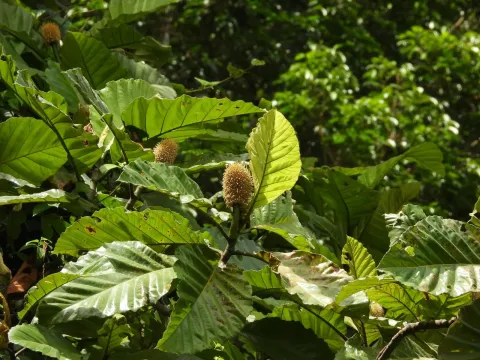
Artocarpus elasticus
Artocarpus elasticus
Artocarpus elasticus, commonly known as terap, is a prominent member of the Moraceae family. This large tropical tree is native to Southeast Asia, thriving particularly in primary and secondary forests across Malaysia, Indonesia, and the Philippines.
What the section contains
Artocarpus elasticus
The climate requirements for this species are centered on high humidity and constant heat. It performs best in regions where annual precipitation is high and well-distributed, ensuring that the tree never faces prolonged water stress during its development.
Regarding soil conditions, Artocarpus elasticus prefers deep, fertile, and well-drained soils. While it can withstand occasional flooding, it performs best on alluvial substrates that provide both structural integrity and a steady supply of nutrients for its rapid growth.
The tree is classified as a sun-loving species. In its natural habitat, it acts as a pioneer species that occupies gaps in the forest canopy. Therefore, agricultural cultivation must ensure sufficient space and light penetration for the canopy to develop properly.
Modern cultivation management focuses on young tree protection and soil moisture control. Regular pruning in the early years helps establish a strong primary stem, which is crucial for maximizing the quality of the trunk in long-term timber production.
The economic utility of Artocarpus elasticus is multifaceted. Its timber is highly regarded for its durability and resistance to decay, making it a preferred material for furniture making, cabinetry, and internal structural components in tropical building projects.
The fruits of the terap tree are widely consumed as a food source. They contain a sweet, aromatic, and fleshy pulp that is highly appreciated by local communities, providing a sustainable fruit crop that can be integrated into agroforestry systems.
The milky latex produced by the tree is a traditional byproduct. While it does not compete with commercial rubber trees, it has historically served as a high-quality adhesive, used for patching holes in canoes or sealing containers in traditional crafts.
Bark fiber extraction is another significant utility. The tree's inner bark provides strong, resilient fibers used in the production of traditional cordage, ropes, and artisanal textiles that are both durable and resistant to the humid environment.
- Timber production for construction and furniture.
- Edible fruit harvest for local markets.
- Latex collection for natural adhesives.
- Fiber extraction from bark for handicrafts.
The long-term yield of this species makes it a valuable asset for forest management. By optimizing planting density and managing the health of the trees, growers can achieve a consistent harvest of both non-timber forest products and high-value logs.