
Cassytha
Cassytha
Cassytha is a genus of parasitic plants belonging to the family Lauraceae. Unlike its relatives in the laurel family, this genus has evolved to live as a stem parasite, completely lacking functional leaves and chlorophyll, which forces it to rely entirely on host plants for survival.
What the section contains

Cassytha
The origin and distribution of Cassytha are primarily concentrated in tropical and subtropical regions. It is particularly diverse in Australia and parts of Africa and Southeast Asia, where climatic conditions support the growth of various host plant species throughout the year.
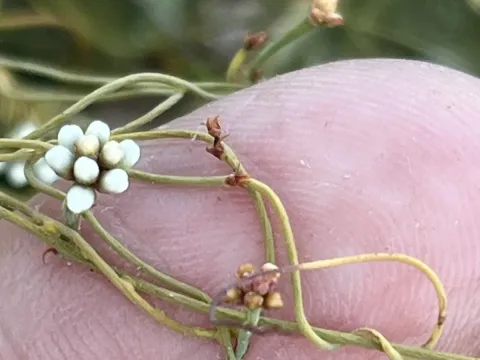
Botanically, the plant is characterized by thin, wire-like stems that coil around the host. It develops specialized structures called haustoria, which penetrate the epidermis of the host plant to tap into its xylem and phloem for water, nutrients, and photosynthates.
Regarding environmental requirements, Cassytha thrives in warm, humid climates. While it does not require fertile soil for its own nutrition, it depends on the presence of susceptible host plants, ranging from native shrubs and trees to cultivated crops in orchard settings.
In terms of agricultural significance, Cassytha is recognized as a problematic pest. It can significantly weaken host plants, leading to reduced vigor, stunted growth, and in severe cases, the death of the colonized plant, which makes it a critical concern for biosecurity.
The primary threats include the ease with which seeds are dispersed by birds and the plant's ability to propagate vegetatively by fragmentation. Because it forms intimate connections with the host, manual removal is often damaging, and chemical control remains a complex challenge for agronomists.