
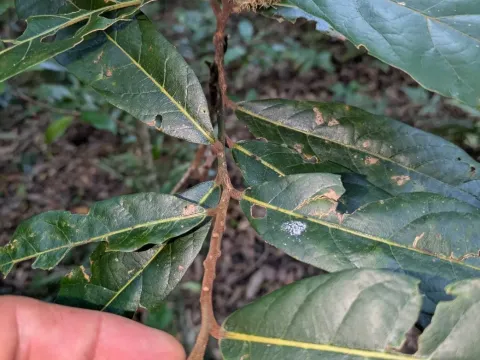
Cryptocarya
Cryptocarya
Cryptocarya is a genus of evergreen trees and shrubs belonging to the Lauraceae family. With over 300 species, these plants are native to the tropical and subtropical regions of Africa, Asia, Australia, and the Americas, occupying various niches in rainforest ecosystems.
What the section contains
 Cryptocarya
 invasiorum
Cryptocarya
Cryptocarya invasiorum
 Cryptocarya agathophylla
Cryptocarya agathophylla
Cryptocarya agathophylla
 Cryptocarya aschersoniana
Cryptocarya crassinervia
Cryptocarya crassinervia
Cryptocarya aschersoniana
Cryptocarya aschersoniana
Cryptocarya crassinervia
Cryptocarya crassinervia
 Cryptocarya densiflora
Cryptocarya densiflora
Cryptocarya densiflora
 Cryptocarya erythroxylon
Cryptocarya erythroxylon
Cryptocarya erythroxylon
 Cryptocarya glaucescens
Cryptocarya griffithiana
Cryptocarya griffithiana
Cryptocarya impressa
Cryptocarya impressa
Cryptocarya glaucescens
Cryptocarya glaucescens
Cryptocarya griffithiana
Cryptocarya griffithiana
Cryptocarya impressa
Cryptocarya impressa
 Cryptocarya kurzii
Cryptocarya kurzii
Cryptocarya kurzii
 Cryptocarya latifolia
Cryptocarya latifolia
Cryptocarya latifolia
 Cryptocarya massoy
Cryptocarya multipaniculata
Cryptocarya multipaniculata
Cryptocarya massoy
Cryptocarya massoy
Cryptocarya multipaniculata
Cryptocarya multipaniculata
 Cryptocarya myrtifolia
Cryptocarya myrtifolia
Cryptocarya myrtifolia
 Cryptocarya nitens
Cryptocarya nitens
Cryptocarya nitens
 Cryptocarya obovata
Cryptocarya obovata
Cryptocarya obovata
 Cryptocarya rigida
Cryptocarya verrucosa
Cryptocarya verrucosa
Cryptocarya rigida
Cryptocarya rigida
Cryptocarya verrucosa
Cryptocarya verrucosa
 Cryptocarya wightiana
Cryptocarya wightiana
Cryptocarya wightiana
 Cryptocarya woodii
Cryptocarya woodii
Cryptocarya woodii
 Cryptocarya wyliei
Cryptocarya zollingeriana
Cryptocarya zollingeriana
Iron Cryptocarya
Cryptocarya ferrea
Cryptocarya wyliei
Cryptocarya wyliei
Cryptocarya zollingeriana
Cryptocarya zollingeriana
Iron Cryptocarya
Cryptocarya ferrea
Cryptocarya
The culture requires a consistent, warm climate to thrive. It is highly sensitive to frost, which limits its commercial cultivation to frost-free zones or specialized greenhouse environments where temperatures are strictly regulated.
Soil conditions for Cryptocarya must prioritize excellent drainage. These plants prefer fertile, slightly acidic, and moisture-retentive loamy soils. Avoiding waterlogged soil is essential, as the roots are highly susceptible to oxygen deprivation.
High relative humidity is a critical requirement for optimal development. In controlled environments, growers often use misting systems to mimic the natural rainforest canopy conditions, which helps in maintaining leaf turgor and metabolic processes.
Standard agronomic practices involve selective pruning to shape the canopy and the application of balanced slow-release fertilizers. Proper spacing is necessary to allow for adequate airflow, reducing the humidity-related stress on the leaves.
Root rot, primarily caused by Phytophthora species, is the most severe threat to Cryptocarya populations. This pathogen thrives in poorly drained soils and can devastate entire groves if the drainage system fails.
Pests such as scale insects and spider mites are common in greenhouses or sheltered outdoor settings. These pests feed on the plant sap, causing yellowing, leaf drop, and overall stunted growth if not addressed promptly.
Fungal infections, including powdery mildew, may affect the foliage if air circulation is restricted. Preventive measures include thinning the canopy and maintaining optimal humidity levels to prevent fungal colonization on the leaves.
Leaf-mining insects can cause cosmetic and physiological damage by creating tunnels in the leaf tissue. Integrated pest management strategies, focusing on biological controls, are highly recommended to preserve the tree's health.
Monitoring the plant's nutrient status is essential, as deficiencies can weaken the tree's natural defense mechanisms. Providing a stable environment and a consistent irrigation schedule remains the best protection against recurring environmental and biotic stresses.