
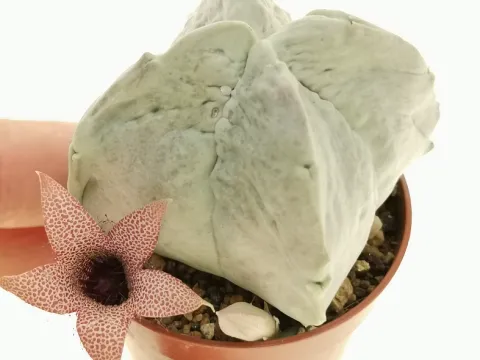
Whitesloanea
Whitesloanea
Whitesloanea (Whitesloanea crassa) is a highly specialized succulent species belonging to the Apocynaceae family. It is a monotypic genus, renowned in the botanical community for its unique, fleshy stems and slow growth rate.
What the section contains

Whitesloanea
The plant originates from the arid regions of Somalia, where it has evolved to thrive in high temperatures and long-term drought. Its natural habitat consists of rocky terrain with minimal nutrient content in the soil.
In terms of cultivation, light is the most critical factor. Whitesloanea requires bright, filtered light throughout the growing season to maintain its characteristic stem structure and healthy green pigmentation.
Soil requirements are strict: the substrate must be almost entirely inorganic. A mix of pumice, lava rock, and coarse sand is recommended to ensure rapid drainage, as the roots are highly sensitive to moisture.
Temperature control is essential for long-term survival. The plant demands warmth during the day and must be kept absolutely dry during the winter dormancy period to prevent the collapse of the root system.
The most common cause of death for Whitesloanea is overwatering, leading to rapid rot. When the substrate remains wet, the succulent tissue absorbs excess water, resulting in cellular lysis and tissue necrosis.
Spider mites represent a significant threat in indoor environments with low humidity. These pests feed on the stem surface, causing unsightly scarring that ruins the ornamental value of the succulent.
Mealybugs are another common pest that tends to hide in the deep, vertical ridges of the plant's stem. They are difficult to eradicate once an infestation has become established within these deep crevices.
Fungal infections, often triggered by poor ventilation, can manifest as dark spots on the stem. Once these spots appear, the infection is often systemic and difficult to cure without significant surgery.
Lack of proper drainage in pots can lead to root asphyxiation. Using heavy or dense potting mixes that do not allow air circulation around the roots will inevitably lead to the plant's decline.