
Encyclia alata
Encyclia alata
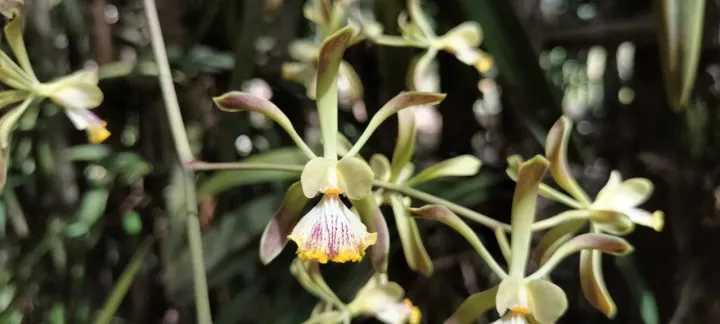
Description
Growing requirements
Encyclia alata is a prominent species within the Orchidaceae family, known for its status as a robust epiphytic orchid. Native to the tropical forests of Central and South America, its natural distribution range spans from Mexico down through Panama, where it colonizes tree trunks and branches.
The plant exhibits distinct botanical traits, including large, pear-shaped pseudobulbs that store moisture for drier periods. Its foliage is characterized by rigid, leathery leaves, while its inflorescence is a notably tall, multi-branched spray of fragrant, long-lasting flowers that feature a unique, wing-like labellum.
Successful cultivation requires high-intensity light levels, ideally filtered to avoid leaf scorch. Providing sufficient light is essential for the plant to achieve the energy balance required to initiate the production of its characteristic heavy flowering spikes.
The environmental requirements demand an intermediate temperature range, with daytime values of +22°C to +28°C and a cooling trend at night. This diurnal temperature variation is a key agrotechnical factor in inducing healthy growth and preventing vegetative stagnation in controlled environments.
Soil management for this species is unique because it grows as an epiphyte; therefore, traditional soil is not used. A loose, inorganic, or bark-based substrate is necessary to ensure rapid water drainage and constant aeration of the root system, which prevents root rot and suffocation.
Main diseases and pests
Major pests affecting this culture include spider mites and scale insects, which thrive in low-humidity environments. Regular inspection and the application of systemic insecticides are standard procedures for maintaining a healthy greenhouse population or individual specimens.
Fungal and bacterial pathogens present the highest risk, particularly when ambient moisture levels are too high or airflow is restricted. Overwatering, especially during the dormant season, often leads to crown rot and pseudobulb decay, which can be fatal if not managed with proper cultural adjustments.