
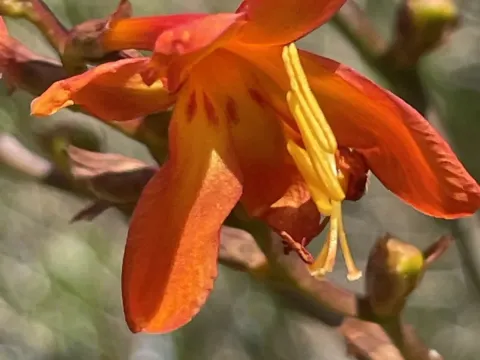
Crocosmia
Crocosmia Planch.
Crocosmia, a member of the Iridaceae family, is a cormous perennial plant that thrives when propagated via corms planted in early spring.
What the section contains
 Crocosmia aurea
 (Pappe ex Hook.) Planch.
Crocosmia hybrids
hybrids between Crocosmia masoniorum (L. Bolus) N. E. Br. and Crocosmia paniculata (Klatt) Goldblatt
Crocosmia aurea
Crocosmia aurea (Pappe ex Hook.) Planch.
Crocosmia hybrids
hybrids between Crocosmia masoniorum (L. Bolus) N. E. Br. and Crocosmia paniculata (Klatt) Goldblatt
 Crocosmia masoniorum
 (L. Bolus) N. E. Br.
Crocosmia masoniorum
Crocosmia masoniorum (L. Bolus) N. E. Br.
 Crocosmia paniculata
 (Klatt) Goldblatt
Crocosmia paniculata
Crocosmia paniculata (Klatt) Goldblatt
 Crocosmia pottsii
 (Baker) N. E. Br.
Crocosmia pottsii
Crocosmia pottsii (Baker) N. E. Br.
 Montbretia
Crocosmia x crocosmiiflora (Lemoine) N. E. Br.
Montbretia
Crocosmia x crocosmiiflora (Lemoine) N. E. Br.
Crocosmia
The optimal planting time occurs when soil temperatures consistently reach +10 degrees Celsius, ensuring rapid root development and foliage emergence.
Corms should be positioned at a depth of 5 to 10 centimeters, depending on the soil texture and the size of the individual planting unit.
Spacings should be maintained at roughly 10 to 15 centimeters apart to facilitate airflow and allow sufficient space for the rapid multiplication of daughter corms.
While seed propagation is possible, it is not the preferred agricultural method due to the extended period required to reach the flowering stage compared to corm planting.
This crop demands full sun exposure to produce high-quality, vibrant flower spikes; growth in shaded conditions leads to weak and prone-to-lodging stems.
Soil requirements prioritize excellent drainage, as the species is highly susceptible to root rot and corm decay in waterlogged, heavy clay environments.
Regular irrigation is essential during the active growing season, particularly before and during flowering, to maintain consistent soil moisture levels.
Soil fertility can be managed through the application of balanced organic fertilizers or compost, which improves the structure and nutrient availability of the root zone.
Winter hardiness varies by cultivar, but in colder zones, providing a thick layer of organic mulch is necessary to protect the underground parts from freezing temperatures.
Spider mites represent a primary pest threat, especially during prolonged periods of drought and high temperatures, leading to leaf discoloration and drop.
Thrips are also problematic, as they pierce the plant tissues and cause cosmetic damage to the flowers and foliage, reducing the overall market value of the crop.
Fusarium wilt is a significant fungal threat that originates in the soil and attacks the vascular system of the corm, often leading to rapid plant collapse.
Botrytis, or gray mold, can infect leaves and stems if humidity levels remain too high, particularly in dense stands with poor airflow.
Integrated pest management strategies, such as routine field monitoring and the use of approved fungicides, are vital for maintaining healthy crop production.
The primary use of Crocosmia is for fresh-cut flower production, where its long-lasting, vibrant inflorescences are valued in commercial floral arrangements.
Harvesting should occur when the lowest buds are fully open, ensuring that the remaining buds on the stem will continue to open after being placed in water.
For propagative purposes, corms are harvested after the foliage has naturally senesced in the autumn, indicating the end of the metabolic cycle.
Post-harvest handling involves cleaning the corms of excess soil and curing them in a cool, well-ventilated location to prepare them for dormancy.
Storage must be maintained at temperatures between +5 and +7 degrees Celsius to prevent rotting or premature sprouting, ensuring high-quality planting stock for the next season.