
American Leaf Spot of Coffee
Mycena citricola
Description
Symptoms
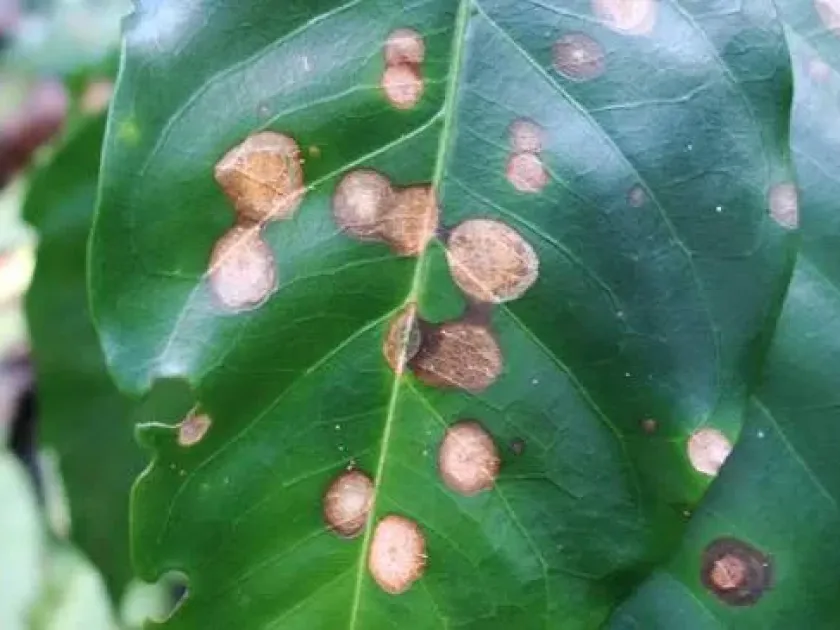
The primary symptoms appear as small, rounded spots on the leaves of coffee plants, including Coffea arabica and Coffea canephora.
As the disease progresses, these spots turn a yellowish or grayish-white color, and the fungus may produce small, distinctive fruiting bodies on the surface of the lesions.
Severe infections lead to chlorosis and premature abscission of leaves, causing the tree to lose its photosynthetic capacity and become significantly weakened.
Young shoots can also be affected, leading to tissue deformation, stunted growth, and an overall reduction in the structural integrity of the coffee plant.
In high humidity, these fungal structures become very apparent, serving as a reliable diagnostic sign for agronomists to identify the presence of the pathogen.
Pathogen
The disease is caused by the fungus Mycena citricola, previously known as Omphalia flavida. It is a significant basidiomycete pathogen affecting coffee plantations in tropical regions.
The fungus actively infects the foliage of coffee trees, using specialized mechanisms to penetrate leaf tissues and absorb nutrients required for its life cycle.
This pathogen survives on infected leaf litter and plant debris, serving as a primary source of inoculum that can initiate new infections every season.
The biological development of the fungus is strictly dependent on high moisture levels, which allow for the germination of its spores and the formation of visible fruiting bodies.
Once established in the host tissue, the fungus aggressively degrades the leaf structure, resulting in the characteristic spotting that inhibits plant productivity.
Conditions for development
The development of Mycena citricola is primarily favored by high relative humidity, frequent rain, and persistent fog, common in many coffee-producing zones.
Optimal temperatures for the fungus range between 20–25°C, providing an ideal environment for mycelial growth and the subsequent release of infectious spores.
Poorly managed plantations with high plant density restrict airflow within the canopy, creating microclimates that retain moisture and promote rapid fungal growth.
Prolonged wet seasons are critical periods where the risk of the disease spreading across entire plantations increases dramatically due to the easy movement of spores.
Neglecting standard agricultural practices, such as failing to prune shade trees or weed management, contributes significantly to the spread of this fungal disease.
Why it matters
The major harm caused by American Leaf Spot is widespread defoliation, which severely reduces the tree's ability to store energy for cherry development and maturation.
Reduced photosynthetic activity leads to lower yields and inferior bean quality, causing significant financial losses for coffee farmers and export operations.
Stressed trees become more susceptible to other secondary pathogens and environmental stressors, leading to a general decline in the long-term health of the plantation.
Without intervention, severe outbreaks can lead to the total loss of the harvest in a single season, threatening the economic stability of the farm.
Continuous infection cycles over several years can permanently reduce the productive lifespan of the coffee trees, necessitating costly plantation renewal.
Protection
Effective management begins with strict sanitation, including the removal of infected fallen leaves and pruning of branches to increase light penetration and air circulation.
Maintaining proper spacing between coffee trees is essential to reduce canopy humidity and minimize the favorable conditions required for fungal sporulation.
Chemical control, specifically the timely application of copper-based or systemic fungicides, is a common strategy in areas prone to high disease pressure.
Regular monitoring of the plantation allows for the early detection of disease focal points, which can then be isolated or treated to prevent widespread epidemics.
Integrated Pest Management (IPM) practices, such as managing shade levels and ensuring balanced nutrient application, can improve tree resistance and reduce the impact of the disease.
Pathogens and affected parts
Affects crops · 2
Discussion
No discussions yet — be the first.