
Coelogyne cumingii
Coelogyne cumingii
Description
Growing requirements
Coelogyne cumingii is an epiphytic orchid species belonging to the Orchidaceae family, native to the tropical regions of Southeast Asia, including the Philippines and Borneo. In its natural habitat, it thrives in humid, shaded forest environments, growing on tree branches where it benefits from constant air circulation and ambient moisture.
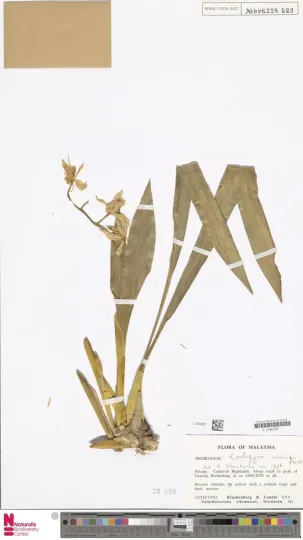
The botanical structure of this plant features sympodial growth with prominent pseudobulbs that store water and nutrients. The leaves are typically lanceolate and leathery, providing durability in varying humidity conditions. The inflorescences emerge from the base of new growths, producing delicate, fragrant flowers that feature a distinct yellow-orange patch on the lip.
To cultivate Coelogyne cumingii effectively, it is essential to maintain a warm environment with temperatures ranging between 18°C and 25°C. The plant performs best in a shaded location, as direct sunlight can easily scorch the foliage. Consistent air movement is crucial to prevent the stagnation of moisture and the development of fungal issues.
The substrate should be lightweight and well-draining, consisting primarily of fir bark, charcoal, and perlite. Because this species is sensitive to mineral accumulation, it is recommended to flush the substrate with pure water occasionally to leach out any salt buildup from fertilizers. High humidity, maintained through regular misting or humidifiers, is vital for healthy growth.
Repotting should be carried out only when necessary, typically every two to three years, as the plant prefers not to be disturbed frequently. When selecting a container, choose pots that provide excellent drainage and are sized appropriately for the root mass, as overly large pots can hold too much moisture and lead to root decay.
Main diseases and pests
Common pests affecting Coelogyne cumingii include spider mites and scale insects, which often thrive in indoor environments with low humidity. Regular inspections of the undersides of leaves and leaf axils are necessary to detect early infestations. If pests are found, they can often be controlled by wiping the foliage with insecticidal soap or neem oil.
Root rot, often caused by overwatering or poor-quality substrate, remains the most significant threat to the health of the plant. If signs of rot appear, such as darkening or softening of the pseudobulbs and roots, the plant must be removed from the container immediately, trimmed of necrotic tissue, and repotted in fresh, dry medium to encourage recovery.