
Bulbophyllum falcatum
Bulbophyllum falcatum
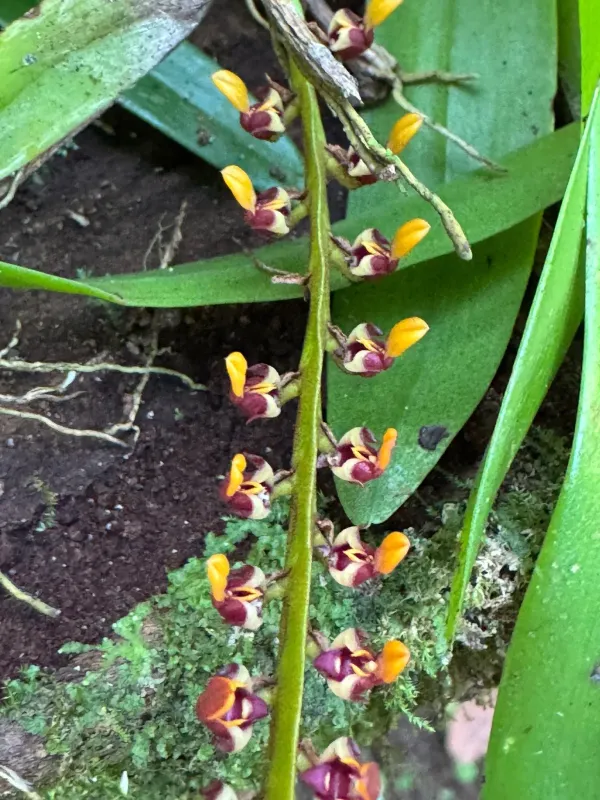
Description
Growing requirements
Bulbophyllum falcatum is an epiphytic orchid species belonging to the Orchidaceae family, native to the tropical regions of West and Central Africa. It typically grows in humid lowland forests, colonizing tree trunks and branches where it can access moisture and nutrient-rich debris.
Successful cultivation of this species requires a stable tropical environment. Growers should maintain daytime temperatures between 22°C and 26°C, with slightly cooler nights to stimulate growth and flowering. It thrives in high humidity, ideally ranging between 70% and 80% to mimic its natural rainforest habitat.
The substrate must be light, airy, and well-draining. Mounted culture on cork or tree fern slabs is often preferred, as it allows for rapid evaporation and prevents root rot. If using containers, a mixture of pine bark, perlite, and charcoal is standard for maintaining healthy root systems.
Light levels should be bright but diffused, as Bulbophyllum falcatum is sensitive to direct sunlight which can scorch its leaves. A location with filtered light or the use of 50-70% shade cloth in greenhouses provides the optimal light intensity for photosynthesis without tissue damage.
Regular watering with high-quality, mineral-low water is essential. The medium should be kept slightly moist but never waterlogged. During the growing season, a dilute, balanced orchid fertilizer applied monthly supports healthy development of the characteristic flattened pseudobulbs.
Main diseases and pests
The primary threats to Bulbophyllum falcatum include fungal and bacterial rots caused by poor air circulation and excessive moisture retention in the root zone. These pathogens can cause rapid necrosis of the pseudobulbs and leaves if left untreated.
Insect pests, specifically spider mites and scale insects, often infest the plant during periods of low humidity. These pests feed on the plant's sap, leading to stunted growth and potentially exposing the plant to secondary viral or bacterial infections.
Effective pest management involves early detection through regular inspection of leaf undersides and pseudobulb crevices. If an infestation occurs, treating the plant with horticultural oils or mild systemic insecticides is usually necessary.
Maintaining a clean growing environment and ensuring proper ventilation are critical preventative measures against both diseases and pests. Sterilizing tools between trimming sessions is also vital to prevent the transfer of pathogens across a collection.
- Ensure continuous gentle airflow to prevent water accumulation.
- Isolate newly acquired plants to check for latent pest populations.
- Promptly remove damaged tissue to stop the spread of infection.