
Brassia angustilabia
Brassia angustilabia
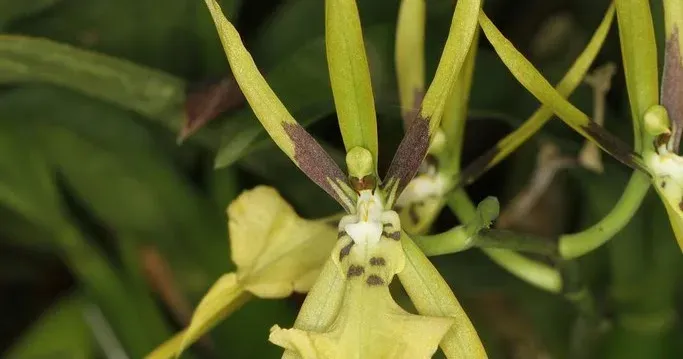
Description
Growing requirements
Brassia angustilabia is an epiphytic perennial plant belonging to the Orchidaceae family. Native to the tropical rainforests of South America, specifically in regions across Brazil and Peru, this species is well-adapted to humid conditions and high canopy habitats where light is filtered through dense foliage.
Botanically, this species is recognized by its sympodial growth habit, featuring flattened pseudobulbs that store water. Its most striking feature is the elongated, narrow labellum of the flowers, which earns it the common association with "spider orchids" due to its distinct, insect-like aesthetic appeal.
Cultivation requires a tropical environment with temperatures consistently between 20°C and 26°C. High humidity levels, ideally maintained between 60% and 80%, are essential for the healthy development of its roots and foliage. Adequate ventilation is also required to prevent moisture-related fungal infections.
The potting medium must provide excellent drainage and aeration. A mixture of pine bark, charcoal, and perlite or sphagnum moss is recommended to simulate natural epiphytic growth conditions. The root system is sensitive to compaction, so the substrate must be replaced every two years to ensure optimal air circulation.
Watering should be balanced, allowing the substrate to partially dry between sessions to avoid root rot. Fertilization should be applied throughout the growing season using a diluted, balanced orchid fertilizer, while reduced watering in the winter helps trigger the necessary rest phase for blooming.
Main diseases and pests
Common pests include spider mites, mealybugs, and scale insects, which frequently infest the undersides of leaves and the base of the pseudobulbs. These pests thrive in indoor environments with low airflow and improper humidity, requiring systemic insecticides or manual removal for effective management.
The primary diseases affecting this culture are bacterial rot and fungal leaf spot, often caused by stagnant water trapped in the leaf axils. Strict sanitation protocols, including the use of sterile cutting tools and maintaining a dry environment around the leaves during the night, are critical for disease prevention.