

Description
How to tell it apart
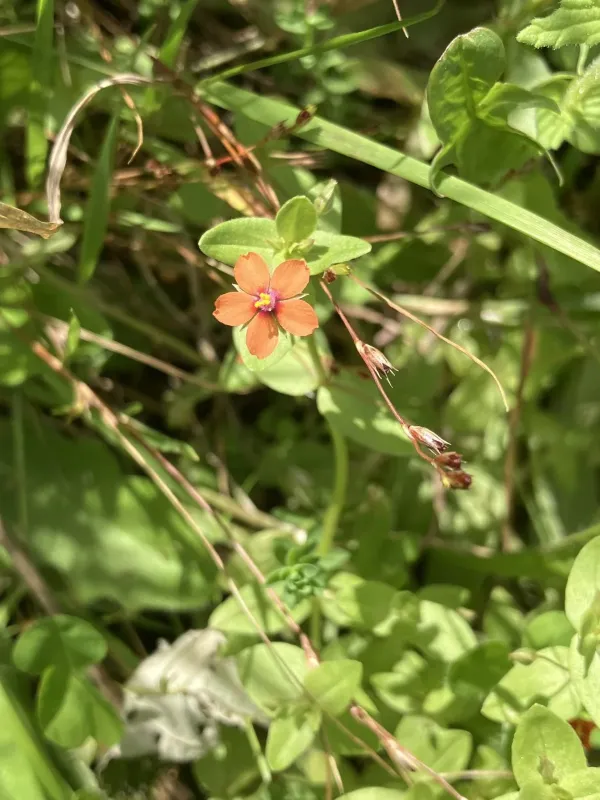
The scarlet pimpernel (Lysimachia arvensis, formerly Anagallis arvensis) is a small annual plant belonging to the Primulaceae family. It is characterized by creeping, four-angled stems that can reach up to 30 cm in length.
The leaves are opposite, ovate, and sessile, often featuring tiny dark glandular dots on the underside, which is a key diagnostic feature for identification in the field.
The flowers are solitary and grow on long stalks from the leaf axils. The petals are usually vivid red or orange, though blue forms exist; the flowers open only in bright sunlight, earning it the nickname "poor man's weather-glass."
The fruit is a globular capsule that splits transversely. It contains numerous small, dark brown, warty seeds capable of remaining viable in the soil for several years.
Biologically, it behaves as an early spring weed that quickly establishes itself in loose and fertile soil, competing with crops for essential resources early in the season.
Where it grows
Scarlet pimpernel is a common weed in agricultural fields, appearing frequently in cereal crops, vegetables, and perennial gardens. It thrives in well-aerated, moisture-rich soils.
It is commonly found on disturbed land, field margins, and neglected areas. Its ability to adapt to varying light conditions makes it a persistent intruder in open crop rows.
The plant is highly resilient and spreads through seed dispersal by wind, water, and human activity, often contaminating machinery and seed supplies.
It prefers sunny environments, which is why it often colonizes fields that have recently been cultivated or where the crop canopy is not yet fully closed.
Its widespread distribution across many continents makes it a significant management concern for farmers operating in diverse climatic regions.
Harm it causes
The primary damage caused by scarlet pimpernel is resource competition. It draws water and nutrients from the soil, directly affecting the vigor and yield of the primary crop.
It is toxic to livestock due to the presence of saponins and glycosides. Ingesting large quantities of the plant, whether fresh or in hay, can lead to severe poisoning in cattle and horses.
The weed acts as a secondary host for various plant pathogens and pests, including aphids, which can vector viruses from the weed to commercially important crops.
Heavy infestations can impede harvesting operations. The succulent nature of the stems can increase the moisture content of the harvested grain, potentially leading to storage issues.
Due to the longevity of its seed bank, even a single uncontrolled season can lead to years of persistent outbreaks on the same plot of land.
How to control
Cultural control is essential; proper seedbed preparation, including stale seedbed techniques, helps to eliminate the first flush of weeds before planting the primary crop.
Crop rotation remains a highly effective method. By rotating cereal crops with competitive legumes or tubers, farmers can interrupt the life cycle of the scarlet pimpernel.
Chemical control involving post-emergence herbicides, such as those containing 2,4-D or MCPA, provides excellent suppression in grain crops during the early growth stages.
In vegetable production, mechanical weeding or the use of pre-emergence herbicides is necessary to prevent the weed from reaching the flowering stage and shedding seeds.
- Implementing deep ploughing in the autumn.
- Using certified, weed-free seeds.
- Performing regular inter-row cultivation.
- Applying herbicides during the 2-4 leaf stage.
Content graph
Connections · Scarlet pimpernel
Most often together:
Marketplace
Products · 14



Terramidin
Nanjing No.1 Pesticide Factory of Red Sun Group Co., Ltd.
Herbicides
0
0
·
1.1K
1 offer
7.61 €per 1 l
Buy




Biology
Taxonomy
- Latin name
- Lysimachia arvensis
- Family
- Первоцветные
- EPPO code
- ANGAR