

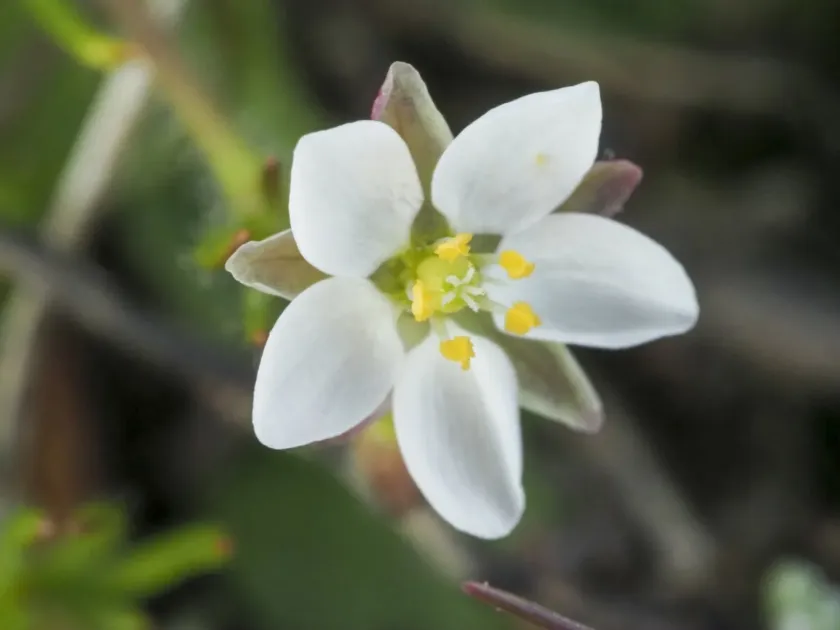
Description
How to tell it apart
Corn spurrey (Spergula arvensis) is an annual herbaceous weed belonging to the Caryophyllaceae family. The plant typically reaches 15 to 40 cm in height and features stems that can be erect or sprawling.
The leaves are linear, needle-like, and arranged in whorls along the stem. They appear in clusters, which is a key diagnostic feature for identification in the field.
Small, white flowers are produced in loose, branching inflorescences. Flowering generally occurs from June through September, depending on the climatic zone.
The seeds are small, round, and flattened, characterized by a distinct narrow wing. A single plant is capable of producing thousands of seeds, contributing to a persistent soil seed bank.
As an early-emerging annual weed, corn spurrey can germinate over a wide range of soil temperatures, often emerging in flushes throughout the spring and early summer.
Where it grows
Corn spurrey prefers acidic, sandy, and peaty soils. It is widely considered an indicator species for soil acidity and low fertility levels in agricultural fields.
It is commonly found infesting cereals, such as oats and rye, as well as row crops like potatoes and sugar beets. It thrives in temperate regions worldwide.
The weed colonizes disturbed areas easily, including fields after harvest, roadsides, and unmanaged fallow lands. It is highly adaptable to moist soil conditions.
In regions with high annual precipitation, corn spurrey can become a major infestation issue, quickly outcompeting crops for space and resources.
Its ability to tolerate poor nutrient conditions allows it to dominate in fields where crop vigor is already compromised by low soil pH or poor drainage.
Harm it causes
The primary damage caused by corn spurrey is intense competition for light and water during the critical early growth stages of the crop.
Its rapid growth habit allows it to shade out young crop seedlings, significantly reducing biomass accumulation and potential harvest yields.
Heavy infestations of corn spurrey interfere with harvesting equipment, as the dense, matted stems can clog machinery and increase moisture levels in harvested grains.
The weed acts as a persistent competitor that depletes soil nitrogen and phosphorus, effectively robbing the main crop of essential fertilizers.
Due to its high seed production and longevity in the soil, it creates a long-term management challenge that requires systematic efforts over multiple seasons.
How to control
Mechanical control involves thorough tillage operations such as autumn plowing, which buries seeds to a depth that prevents successful germination.
Soil amendment through liming is a highly effective strategy, as corn spurrey is significantly less competitive and less frequent in neutral or slightly alkaline soils.
Chemical control utilizing selective herbicides is often necessary in cases of heavy infestation. Applications should target the weed during its early seedling stages.
- Implementing diverse crop rotation strategies.
- Using high-quality, certified, and weed-free seeds for planting.
- Timely inter-row cultivation in row crops to disrupt growth.
Integrated weed management combining timely cultivation and appropriate chemical controls provides the best results for sustainable field productivity.
Content graph
Connections · Corn spurrey
Most often together:
Marketplace
Products · 14


Biceps Guarant
ЗАТ Фірма Август, Росія.,селище Вурнари,
Herbicides
0
0
·
2.4K
7 offers
0.63 €per 1 l
Buy


Trimer
Цзянсуський завод отрутохімікатів «Жуй Бан», Джітан , Китай.
Herbicides
0
0
·
1.6K
1 offer
85.35 €per pack
Buy





Biology
Taxonomy
- Latin name
- Spergula arvensis
- Family
- Гвоздичные
- EPPO code
- SPRAR