
Common duckweed (Wolffia)
Wolffia arrhiza
Description
How to tell it apart
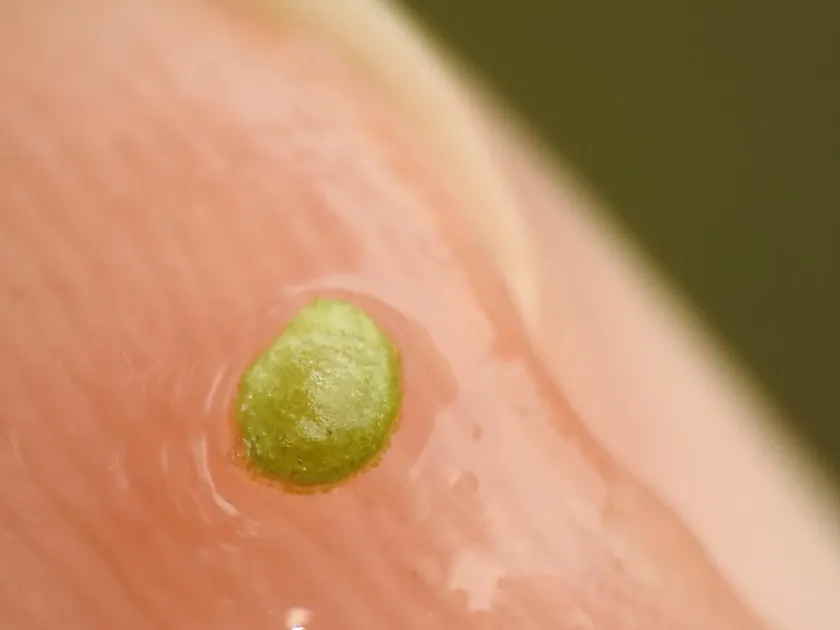
Wolffia arrhiza, known as rootless duckweed, is the smallest flowering plant on Earth, belonging to the Araceae family. It consists of a tiny green oval body, or frond, ranging from 0.5 to 1.5 mm in diameter.
The plant lacks any roots, leaves, or stems, manifesting as a simple vegetative thallus. The surface is smooth and bright green, sometimes featuring minute brownish spots.
Reproduction is primarily vegetative through budding, allowing the plant to rapidly cover water surfaces during warm summer months.
Flowers are extremely rare and microscopic, developing within a small depression on the upper side of the frond, making them almost impossible to see with the naked eye.
Unlike other duckweed species (Lemna), Wolffia has no hanging rootlets, appearing as a thick, granular green powder floating on the water's surface.
Where it grows
This species thrives in still or slow-moving freshwater bodies, such as ponds, marshes, ditches, and flooded rice paddies, which are rich in organic nutrients.
High water temperatures and high nitrogen availability significantly accelerate the growth rate of this species, often leading to rapid colonization of irrigation channels.
In agricultural settings, particularly rice production, Wolffia can become a major nuisance by occupying the water surface and altering the microclimate of the paddy.
Dispersal occurs passively through water movement, as well as via waterfowl and aquatic animals that carry the tiny fronds on their bodies or feet.
It survives cold periods by sinking to the bottom of the water body and returning to the surface when temperatures reach optimal levels in the spring.
Harm it causes
The dense mats formed by Wolffia reduce light penetration into the water column, inhibiting the growth of underwater vegetation and young rice seedlings.
The extensive surface coverage restricts gas exchange, which can lead to low dissolved oxygen levels, adversely affecting the aquatic environment.
Wolffia competes with crops for nutrients like nitrogen and phosphorus, reducing the efficiency of fertilization practices in irrigated agriculture.
Heavy infestations block irrigation gates and drainage pipes, significantly increasing maintenance costs for farmers and water management districts.
Decomposing biomass from massive Wolffia blooms can degrade water quality, potentially causing anaerobic conditions and unpleasant odors in the water body.
How to control
Effective management requires a combination of physical and biological strategies to prevent the buildup of dense populations throughout the irrigation season.
Maintaining a flow of water through fields and irrigation channels can significantly reduce the ability of Wolffia to establish itself in a specific area.
Physical removal through fine-mesh nets or filtration systems is possible for small ponds but remains labor-intensive and impractical for large-scale rice cultivation.
Biological control using herbivorous fish species, such as grass carp (Ctenopharyngodon idella), has proven effective in reducing the total biomass of the weed.
- Regular monitoring of water sources to prevent initial infestation.
- Application of specialized aquatic-approved herbicides that disrupt plant cell integrity.
- Drainage and drying of rice paddies during fallow periods to kill off floating biomass.
Taxonomy
- Latin name
- Wolffia arrhiza
- Family
- Ароидные
- EPPO code
- WOLAR