
Common duckweed
Lemna minor
Description
How to tell it apart
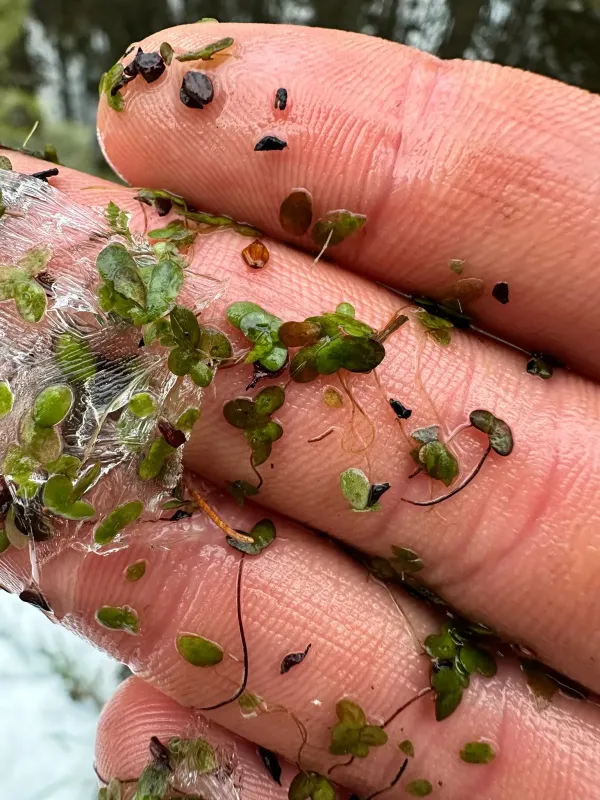
Common duckweed (Lemna minor) is a small perennial aquatic plant belonging to the Araceae family. It is a free-floating macrophyte that lacks distinct stems and leaves.
The plant body consists of a flattened green structure known as a frond, measuring approximately 3–8 millimeters, with a single thread-like root hanging into the water.
It propagates primarily through vegetative budding, where new fronds emerge from the parent plant, allowing it to colonize water surfaces at an extremely rapid rate.
Flowering is an infrequent occurrence in this species. The flowers are extremely small and vestigial, playing a negligible role in the plant's overall reproduction strategy.
To survive cold winter conditions, the plant produces specialized dormant structures called turions, which sink to the bottom and resurface during the following spring.
Where it grows
Lemna minor is cosmopolitan, occurring in almost all temperate and tropical regions. It thrives in still or slow-moving freshwater bodies, such as ponds, ditches, and swamps.
In agriculture, it is particularly problematic in paddy fields, where it forms dense mats that block sunlight, negatively impacting the development of rice seedlings.
The plant is highly nitrophilous, preferring water bodies rich in nutrients, especially phosphorus and nitrogen, often resulting from agricultural runoff.
Common duckweed is highly adaptable and can survive in a wide range of temperatures, enabling it to rapidly dominate diverse aquatic environments.
Exposure to direct sunlight encourages the most rapid growth, allowing the plant to cover the entire surface area of small ponds in a matter of weeks.
Harm it causes
The primary environmental damage caused by duckweed is the blocking of sunlight, which inhibits the photosynthesis of submerged plants and essential phytoplankton.
The formation of dense mats prevents atmospheric oxygen from dissolving into the water, potentially leading to hypoxia, which can kill fish and other aquatic fauna.
In rice production, duckweed competes for essential minerals in the water, significantly reducing nutrient availability for the crop and lowering overall yields.
Accumulation of the weed in irrigation canals and drainage systems impedes water flow, leading to inefficiencies in agricultural water management.
Dense populations interfere with mechanical maintenance of irrigation infrastructure and complicate access to water for agricultural or aquaculture purposes.
How to control
Mechanical removal is the most common manual control method, involving the use of booms, nets, or rakes to clear the surface of the water.
Improving water circulation via aeration or mechanical pumps can significantly reduce the potential for duckweed colonization, as the plant prefers stagnant conditions.
Chemical control involves the use of aquatic-approved herbicides that disrupt the plant’s biological processes, though careful selection is needed to protect non-target species.
Reducing nutrient loading into the water by managing agricultural runoff and limiting fertilizer leaching is critical for long-term population control.
- Mechanical scooping and skimming.
- Biological control using herbivorous fish species.
- Application of specialized aquatic herbicides.
- Reducing nutrient input (eutrophication control).
Taxonomy
- Latin name
- Lemna minor
- Family
- Ароидные
- EPPO code
- LEMMI