
Wolffia
Wolffia
Description
How to tell it apart
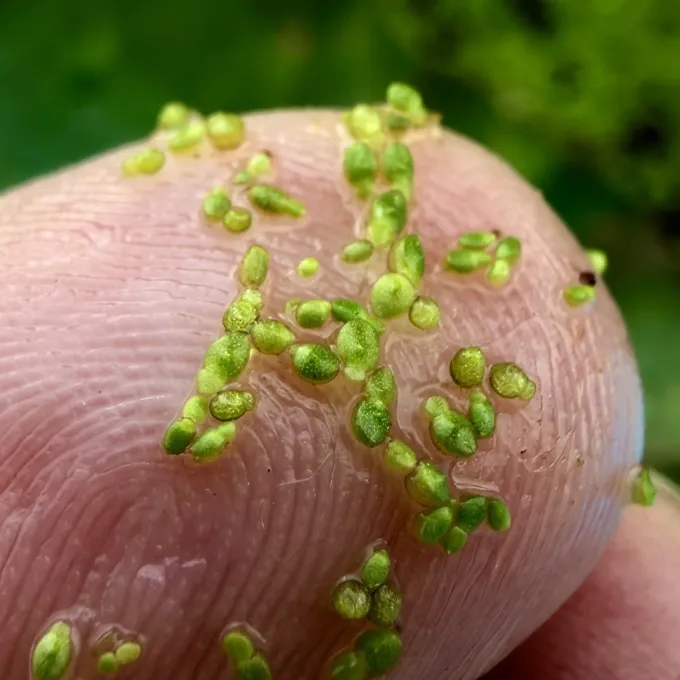
Wolffia (Wolffia arrhiza), a member of the Araceae family, holds the title of the world's smallest flowering plant. It appears as a tiny green, globe-shaped or elliptical body, measuring approximately 1 to 1.5 millimeters in diameter.
The plant completely lacks roots and true leaves, consisting instead of a single flattened or spherical segment known as a frond. Its lack of roots serves as the primary visual key to distinguish it from common duckweed species.
It reproduces primarily through rapid budding, where daughter segments detach from the parent. Under favorable conditions, these colonies can cover the entire surface of stagnant water bodies within a remarkably short period.
Flowers are extremely rare and microscopic, appearing in a tiny pit on the upper side of the frond. Because they are virtually invisible to the naked eye, flowering plays no role in the identification or agricultural assessment of this weed.
As a hydrophyte, Wolffia is highly sensitive to water quality. It flourishes in eutrophic water bodies, making it a reliable biological indicator of high nutrient levels, particularly nitrogen and phosphorus.
Where it grows
Wolffia is widely distributed across tropical and temperate regions worldwide. In its natural environment, it occupies stagnant or slow-moving water bodies such as ponds, marshes, and oxbow lakes where wind and current cannot disrupt the colony.
In an agricultural context, it is a significant pest in rice paddies and irrigation systems. It thrives in standing water, utilizing the nutrient-rich environment created by fertilizers that leach from surrounding fields.
The plant prefers areas with maximum sun exposure and stable temperatures. It thrives in the range of +20°C to +30°C, conditions frequently found in shallow rice fields during the early stages of the growing season.
Irrigation canals are particularly prone to infestation, as the lack of flow and high organic matter provide ideal conditions for growth. Once established, Wolffia can spread through the entire water supply network of a farm.
High nitrogen concentrations resulting from agricultural runoff trigger explosive growth cycles, turning clear water into a dense, green mat that persists until environmental factors or control measures intervene.
Harm it causes
The primary agricultural damage caused by Wolffia is the physical blocking of sunlight from entering the water column. This inhibits the warming of the water, which is critical for the early development of rice seedlings.
As an aggressive consumer of dissolved nutrients, Wolffia competes directly with rice plants for nitrogen, phosphorus, and trace minerals. This nutrient depletion often leads to visible stunting and reduced yields in infested areas.
In irrigation systems, Wolffia causes significant operational issues. The dense colonies clog intake screens, pumps, and nozzles, necessitating frequent maintenance and leading to increased costs in managing water delivery.
Massive die-offs of Wolffia create severe oxygen depletion in the water. As the organic matter decomposes, it can lead to hypoxic conditions, which are harmful to the aquatic ecosystem and may negatively impact the soil health within the paddy.
The continuous mat of Wolffia also interferes with gas exchange at the water-air interface. This alters the overall environmental conditions within the rice field, potentially disrupting the natural biological processes of the paddy soil.
How to control
Agrotechnical management starts with maintaining clean irrigation canals. Regularly clearing organic debris and weeds before the season prevents the early buildup of Wolffia populations.
Implementing a flow system is a highly effective control measure. Wolffia thrives in still water, so even a consistent, gentle flow can inhibit its ability to form the dense mats necessary for survival and spread.
Chemical control involves the application of registered aquatic herbicides. It is crucial to select products that are effective against Wolffia while minimizing toxicity to fish and other desirable aquatic organisms in the ecosystem.
Biological control, such as introducing herbivorous fish like grass carp, can help manage populations. However, due to Wolffia's microscopic size, this method may require careful planning and population monitoring.
Mechanical removal, while labor-intensive, is a safe and eco-friendly method. Using fine mesh screens or skimming devices can clear local infestations effectively without the risks associated with chemical treatments.
Taxonomy
- Latin name
- Wolffia
- Family
- Ароидные
- EPPO code
- WOLSS