
Greater duckweed
Spirodela polyrrhiza
Description
How to tell it apart
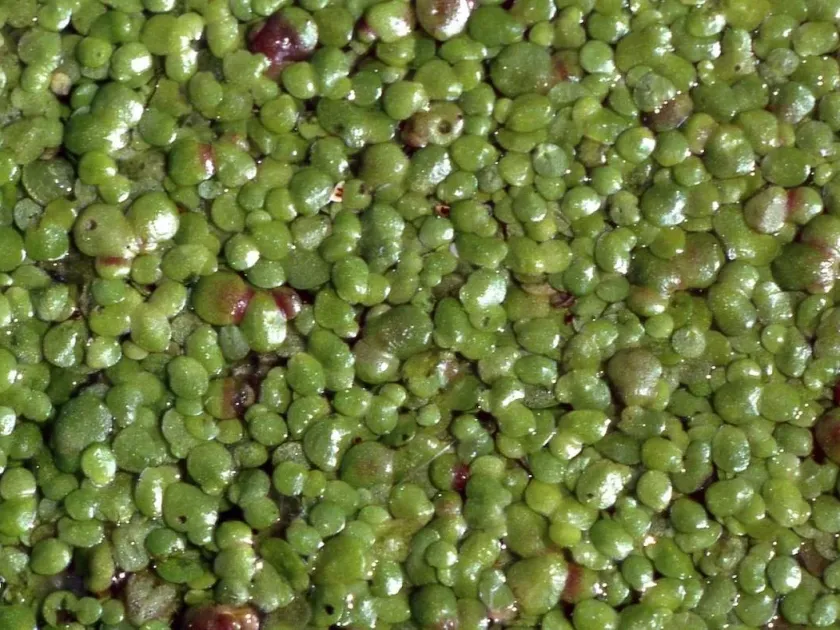
Greater duckweed (Spirodela polyrrhiza) is a small aquatic plant belonging to the Araceae family that floats on the surface of standing water.
It is distinguished from common duckweed by the presence of a cluster of several roots (5 to 15) beneath each frond, whereas common duckweed possesses only a single root.
The fronds are broad, 5–10 mm in diameter, dark green on the upper surface and typically reddish or purple underneath due to anthocyanin pigmentation.
The plant multiplies rapidly through vegetative reproduction, creating dense green mats that cover entire sections of ponds or irrigation canals.
During the autumn, the plant produces specialized resting buds known as turions that sink to the bottom to survive the winter temperatures.
Where it grows
Spirodela polyrrhiza thrives in nutrient-rich, stagnant, or slow-moving water bodies, such as ponds, marshes, and irrigation ditches.
In agricultural settings, it is commonly found in rice paddies and water-delivery systems where runoff from fertilizers provides an abundance of nitrates and phosphates.
The plant prefers warm, shallow areas with high light exposure, which facilitates rapid colonization and bloom-like coverage.
It is easily transported between water systems by waterfowl or by flowing water during heavy rainfall events.
Its high adaptability allows it to persist in various environmental conditions as long as the water is relatively calm and nutrient levels are sufficient.
Harm it causes
The dense cover of greater duckweed prevents sunlight from penetrating the water, which halts photosynthesis for submerged plants and reduces oxygen levels.
In irrigation networks, it clogs intakes and canals, significantly reducing water flow capacity and complicating the maintenance of infrastructure.
In rice production, it acts as a competitor for light and dissolved nutrients, suppressing the development of crop seedlings in their early stages.
Rapid death and decomposition of the biomass can degrade water quality, causing spikes in ammonium levels that are toxic to fish and other aquatic fauna.
The plant's physical presence hinders the use of water pumps and manual agricultural tasks, increasing operational costs for farm water management.
How to control
Mechanical control is the most direct method, involving the removal of the floating mats using nets, skimmers, or specialized aquatic weed harvesters.
Reducing nutrient runoff from surrounding agricultural fields is essential to starve the plant and slow its proliferative rate in water reservoirs.
Water level management, such as periodic drawdown of canals or ponds, can expose the plants to desiccation and effectively reduce their populations.
Chemical control with aquatic-approved herbicides may be used, though it requires precise application to avoid negative impacts on the surrounding ecosystem.
- Mechanical biomass removal.
- Nutrient load reduction in runoff.
- Water level manipulation.
- Targeted aquatic herbicide use.
Taxonomy
- Latin name
- Spirodela polyrrhiza
- Family
- Ароидные
- EPPO code
- SPIPO