
Water lettuce
Pistia stratiotes
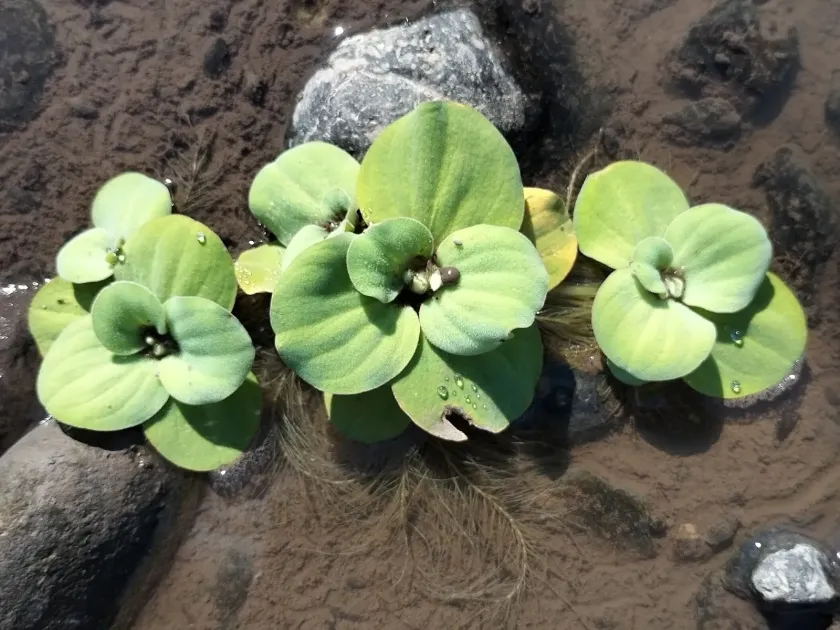
Description
How to tell it apart
Water lettuce, scientifically known as Pistia stratiotes, belongs to the Araceae family. It is a free-floating aquatic perennial that does not root in the soil.
The plant features a rosette of velvety, blue-green leaves that form dense, mat-like colonies. The leaves are covered in fine hairs that trap air, providing the necessary buoyancy.
The root system consists of feathery, hanging roots that can reach lengths of up to 50 cm. These roots are highly efficient at absorbing nutrients directly from the water column.
Propagation is primarily vegetative through the development of lateral stolons, which produce daughter rosettes at a rapid rate, quickly covering vast areas of water.
Its flowers are small, inconspicuous, and hidden within the foliage, contributing little to the plant's overall appearance but allowing for seed production under specific conditions.
Where it grows
Water lettuce thrives in warm, stagnant, or slow-moving water bodies rich in organic matter. It is commonly found in ponds, lakes, and extensive irrigation networks.
Being highly sensitive to cold, the plant is most invasive in tropical and subtropical regions. In colder climates, it acts as an annual, as it is killed by frost.
In agricultural settings, it frequently obstructs irrigation channels, blocking water flow and disrupting the supply needed for crop cultivation and field management.
The species is highly invasive and spreads rapidly when introduced to new water bodies, often through the aquarium trade or accidental transport by human activity.
Optimal growth conditions involve high light intensity and water temperatures ranging from 20 to 30 degrees Celsius, where it can double its population within days.
Harm it causes
The primary environmental impact of water lettuce is the formation of thick surface mats that block sunlight from penetrating the water, suppressing phytoplankton growth.
The reduction in light and oxygen leads to poor water quality, causing fish kills and the loss of native aquatic biodiversity within the infested ecosystem.
Agriculture suffers when water lettuce clogs irrigation pumps, intake filters, and floodgates, causing significant delays and costs in maintenance and water delivery.
The plant interferes with recreational activities such as boating, fishing, and swimming, while decaying masses contribute to nutrient loading and foul odors in the water.
It also increases water loss through evapotranspiration, which can exacerbate water shortages in arid climates and reduce the capacity of reservoirs.
How to control
Mechanical control is the most common method, involving the physical removal of the weed using specialized skimmers, harvesters, or rakes to clear channels and ponds.
Source reduction is vital; by decreasing nutrient runoff (nitrogen and phosphorus) into water bodies, the growth rate of the weed can be significantly slowed.
Chemical control involves the application of aquatic-labeled herbicides, such as those containing glyphosate or diquat, which are effective in killing the plant mats.
Caution must be exercised during herbicide application to avoid toxicity to fish and non-target aquatic organisms, especially when the water is used for irrigation.
Biological control programs, using host-specific insects like the water lettuce weevil, have been implemented successfully in various regions to provide long-term management.
Taxonomy
- Latin name
- Pistia stratiotes
- Family
- Ароидные
- EPPO code
- PIIST