

Description
How to tell it apart
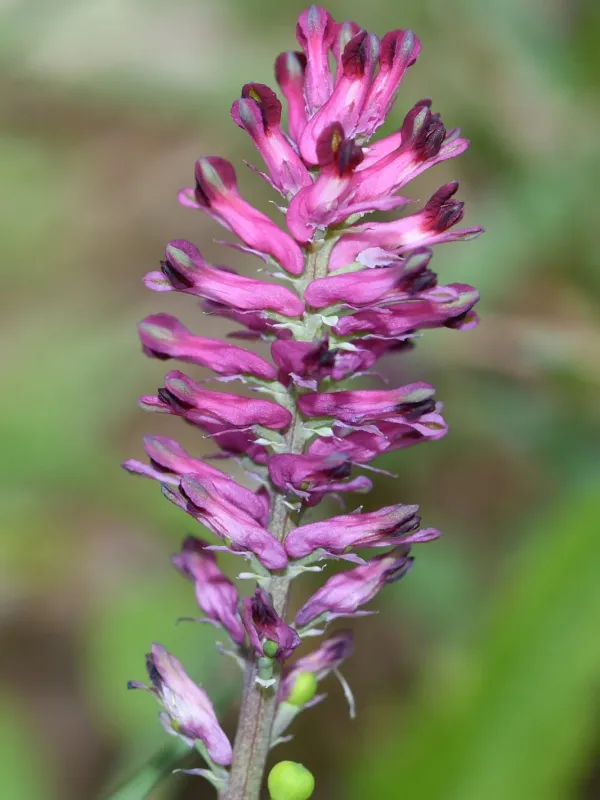
Common fumitory (Fumaria officinalis) is an annual herbaceous plant belonging to the Fumariaceae family. Its stems are branching, trailing or climbing, reaching heights of 20 to 50 cm.
The leaves are alternate and finely divided into narrow, glaucous-green segments, giving the plant a delicate, lace-like appearance throughout its growing season.
Flowers are arranged in dense racemes, characterized by a pinkish-purple color with a darker, often reddish or deep-pink tip, which is a key identification feature.
The fruits are single-seeded, globose nuts that are slightly flattened. The plant germinates primarily in early spring, establishing itself before many crop species have fully developed.
It possesses a thin, taproot system that allows it to thrive in various soil types, particularly those that are well-cultivated and possess good moisture retention levels.
Where it grows
Common fumitory is widely distributed across temperate regions and is considered a frequent weed in agricultural fields, kitchen gardens, and neglected landscape areas.
It favors fertile, loamy soils and is frequently found in cereal crops, orchards, and vegetable plots, often appearing in areas where the soil has been disturbed.
The plant is highly adaptable to various environmental conditions but prefers open, sunny locations with sufficient nutrient availability to support its rapid development.
Its high reproductive potential is a major challenge; a single plant can produce thousands of seeds that remain viable in the soil seed bank for several years.
Seed dispersal is facilitated by farming equipment, irrigation runoff, and the movement of contaminated manure, allowing the weed to spread quickly across agricultural parcels.
Harm it causes
Common fumitory competes aggressively with crops for water, sunlight, and soil nutrients, particularly during the early seedling stage when crops are most vulnerable.
Large patches of the weed can significantly reduce crop yields by shading out young plants and inducing stunted growth, which ultimately affects the overall biomass of the harvest.
High levels of infestation interfere with mechanical harvesting operations, potentially damaging equipment or causing significant clumping of harvested materials.
As a host for various insects and plant pathogens, it can act as a bridge for diseases to transition from field margins into the crop, complicating integrated pest management.
Seed contamination in harvested cereal lots results in reduced grain quality, necessitating extra cleaning costs or causing financial losses due to lower grading standards.
How to control
Integrated weed management starts with a diverse crop rotation that breaks the life cycle of common fumitory and depletes the soil seed bank through varied cultivation practices.
Effective seedbed preparation, including stale seedbed techniques, helps to induce germination of weed seeds, which can then be destroyed before the main crop is sown.
- Rigorous cleaning of seeds to prevent introduction.
- Mechanical harrowing at the cotyledon stage.
- Use of selective herbicides during the rosette stage.
- Maintaining optimal crop density for better shading.
- Proper management of field margins and fallow areas.
Chemical control involves the application of selective herbicides; timing is critical, as control is most effective when plants are small and actively growing before flowering.
Rotating herbicide modes of action is recommended to mitigate the risk of resistance development, ensuring long-term control effectiveness in modern farming systems.
Content graph
Connections · Common fumitory
Most often together:
Marketplace
Products · 139

PILOT, KS, (METAMITRON, 700 G/L)
ZAT «August-Bel», Republic of Belarus
Herbicides
0
0
·
52
1 offer
0.19 €per 1 l
Buy


Slash, EC
Доу АгроСайенсіс С.А.С., Друзенхайм, Франція
Herbicides
0
0
·
49
5 offers
7.59 €per 1 l
Buy


IMPERIAL, RC
Nantong Pesti Agrochemical Limited Company, Nantong, КНР
Herbicides
0
0
·
45
3 offers
1.43 €per 1 l
Buy

Bridger k.e.
Ф.Меатон Лімітед, Лондон, Великобританія.
Herbicides
0
0
·
44
2 offers
14.04 €per 1 l
Buy


DICBAN
Ф.Суперус Ко ., Лтд., Гонг-Конг, Шанхай, Китай.
Herbicides
0
0
·
43
2 offers
9.02 €per 1 l
Buy


MATAR, KS (METRIBUZIN, 600 G/L)
Hangzhou Ruijiang Chemical Co., Ltd.
Herbicides
0
0
·
39
2 offers
33.29 €per 1 l
Buy

Alpha - Brigade k.e.
F. YUNISITY ENTERPRISES LTD., United Kingdom
Herbicides
0
0
·
39
2 offers
13.93 €per 1 l
Buy


Grinfort BZ 480, RK (bentazon, 480 g/l)
АгроМаксі, ТОВ
Herbicides
0
0
·
33
2 offers
0.39 €per 1 l
Buy


Betalon-X, KE (desmedifam, 71 g/l + fenmedifam, 91 g/l + etofumezat
Jiangsu Good Harvest-Weien Agrochemical Co., Ltd, Китай.
Herbicides
0
0
·
30
2 offers
12.42 €per pack
Buy

ALPHA-DICAMBA, EC
«Юнісіті Ентерпрайсіс Л.П.», Единбург, Великобританія
Herbicides
0
0
·
28
2 offers
10.27 €per 1 l
Buy


Stefam Noviy, KS (fenmedifam, 160 g/l + desmedifam, 160 g/l)
ДДЕ Фарм АГ, Тризен, Ліхтенштейн
Herbicides
0
0
·
22
1 offer
16.8 €per 1 l
Buy


Gerber
Superus Co., Ltd., Китай, Yangzhou Pioneer Chemical Co., Ltd., Китай
Herbicides
0
0
·
1.9K
No offers
—
Details


Bentagran AS
Nanjing No.1 Pesticide Factory of Red Sun Group Co., Ltd.
Herbicides
0
0
·
999
No offers
—
Details

Belveder
Finkemü Schwebda, F.GmbH, GERMANY, MEMBER OF GROUP
Herbicides
0
0
·
872
No offers
—
Details


Goldbit 700 g/l (Metamitron 700 g/l)
F.A.GAN Chemical Manufacturers Ltd. Israel, member
Herbicides
0
0
·
55
No offers
—
Details
Randeau, WG (triflusulfuron-methyl, 500 g/kg)
Аріста ЛайфСайенс С.А.С., Ногер, Франція
Herbicides
0
0
·
53
No offers
—
Details

PHENIZAN, WATER-SOLUBLE CONCENTRATE
ЗАТ Щелково Агрохім , Росія.
Herbicides
0
0
·
52
No offers
—
Details


Alpha-Pyradiol w.r.k.
«Юнісіті Ентерпрайсіс Л.П.», Единбург, Великобританія
Herbicides
0
0
·
50
No offers
—
Details
Biology
Taxonomy
- Latin name
- Fumaria officinalis
- Family
- Однолетние двудольные сорняки