

Description
How to tell it apart
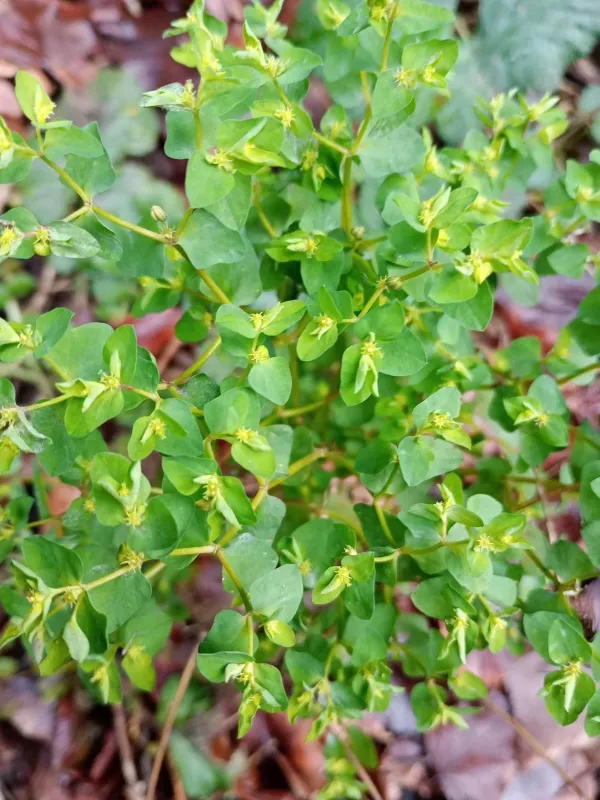
Petty spurge (Euphorbia peplus) is an annual herbaceous plant belonging to the Euphorbiaceae family. In agronomic terms, it is classified as a small, early-season weed that spreads exclusively through seed dispersal.
The plant typically reaches a height of 10 to 30 cm. It has a smooth, branched stem, often with a reddish hue. The leaves are obovate, slightly glaucous, and arranged alternately along the stem on short petioles.
The flowers are arranged in complex umbel-like inflorescences surrounded by characteristic yellowish-green bracts. Flowering occurs from June through September, allowing the plant to produce multiple generations of seeds within a single season.
When any part of the plant is injured, it exudes a white, milky latex. This sap contains diterpene esters that are toxic and irritating, serving as a chemical defense mechanism against many herbivores and insect pests.
The root system is a slender taproot capable of reaching deep into the soil. The fruit is a small, three-lobed capsule that explosively dehisces upon drying, scattering seeds several centimeters away from the parent plant.
Where it grows
Petty spurge is widely distributed in temperate regions and favors fertile, loose, and moist soils. It is commonly found in gardens, greenhouses, vegetable plots, and nurseries where regular irrigation is maintained.
In agricultural settings, it frequently infests row crops such as vegetables and root crops. It is also common in disturbed areas, along paths, and in waste ground where soil nutrients are high but competition is initially low.
The plant is highly adaptable, thriving in both full sun and partial shade. However, it does not tolerate soil compaction well and can be easily suppressed by dense, well-established vegetation or thick ground cover.
Seeds of Euphorbia peplus remain viable in the soil for several years. Dispersal is primarily mediated by irrigation water, contaminated nursery stock, or soil movement on gardening tools and footwear.
Due to its rapid growth cycle, the weed quickly fills gaps between crop rows. If left unmanaged, it can form dense local patches that outcompete slower-growing seedlings during the critical stages of crop development.
Harm it causes
The primary harm caused by Petty spurge is its competitive impact on nutrient and water uptake. Because it establishes quickly, it effectively steals resources from the main crop during the early stages of the growing season.
This species acts as a reservoir for various plant viruses. Aphids and other vectors often feed on spurge before migrating to vegetable crops, transmitting pathogens that significantly reduce both yield quality and quantity.
Dense mats of this weed can increase humidity at the soil surface, which promotes the development of soil-borne fungi and various root rots. This is particularly problematic in dense vegetable stands where air circulation is limited.
The milky latex is toxic to livestock, and while direct ingestion is rare in intensive horticulture, it remains a concern when contaminated plant material is incorporated into fodder or improperly composted manure.
Economic losses are also incurred due to labor costs for manual weeding. Because Petty spurge can produce several generations per year, it requires persistent management efforts throughout the entire growing season to keep infestation levels low.
How to control
The most effective cultural control method is regular mechanical cultivation of soil between rows. It is critical to remove the weed before flowering occurs to prevent seed set and the replenishment of the soil seed bank.
Mulching the soil surface with straw, bark, or landscape fabric is highly effective. By blocking sunlight, mulch prevents the germination of seeds and the establishment of new petty spurge seedlings.
Crop rotation and the use of cover crops can significantly suppress Petty spurge. Planting fast-growing cover crops creates a dense canopy that outcompetes the light-loving spurge for space and nutrients.
In large-scale field operations, chemical control may be necessary. Pre-emergence or post-emergence herbicides should be used in accordance with regional regulations, focusing on products labeled for the specific crop being grown.
- Deep cultivation to bury seeds and prevent them from germinating.
- Consistent removal of weeds throughout the summer to exhaust the seed bank.
- Usage of competitive cover crops to suppress weed growth.
- Selective herbicide application using hooded sprayers to minimize crop damage.
Reference
Connections · Petty spurge
Most often together:
Marketplace
Products · 1
Biology
Taxonomy
- Latin name
- Euphorbia peplus
- Family
- Молочайные
- EPPO code
- EPHPE