
Rattlesnake weed
Euphorbia albomarginata
Description
How to tell it apart
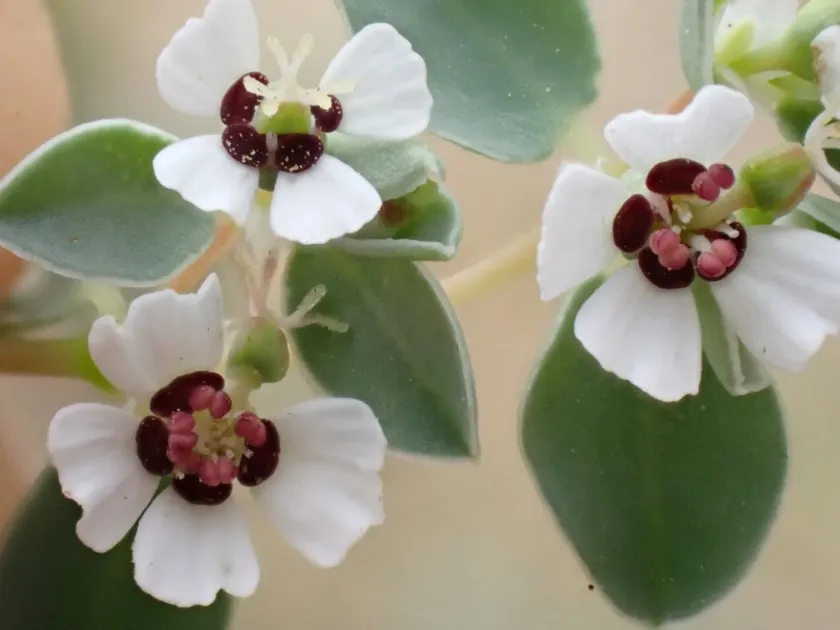
Rattlesnake weed (Euphorbia albomarginata) belongs to the Euphorbiaceae family. It is a perennial herbaceous plant that grows in low, mat-like clusters spreading across the ground.
The stems are slender, often tinged with red, and highly branched. The leaves are small, arranged oppositely, and feature a distinct white or light-green margin, which gives the plant its name.
The flowers are inconspicuous and hidden within specialized structures called cyathia. Like other members of the genus, the plant exudes a milky latex sap when any part is damaged.
The root system is robust and can penetrate deeply into the soil, allowing the plant to endure prolonged droughts and recover quickly from mechanical damage.
The plant demonstrates a high capacity for vegetative reproduction, ensuring its persistence and dominance in challenging environmental conditions.
Where it grows
This species is commonly found in open, disturbed areas. It thrives in pastures, along roadsides, on vacant land, and within abandoned agricultural fields.
Rattlesnake weed prefers sandy or loamy soils with low moisture levels. It is exceptionally well-adapted to areas with high solar radiation and surface heat.
In cultivated fields, it appears most frequently in row crops or in areas with sparse canopy cover where competition for sunlight is reduced.
It colonizes areas with disturbed topsoil where a lack of dense vegetation allows seeds to germinate and stems to root effectively without competition.
Its natural range includes arid regions where the plant successfully outcompetes native flora for limited nutrient resources and soil water.
Harm it causes
The primary concern regarding this weed is its toxicity. The milky latex sap contains compounds that can cause skin and mucous membrane irritation in livestock if consumed.
In grazing lands, the weed spreads rapidly, displacing nutritious forage grasses and significantly reducing the overall productivity of pasture ecosystems.
In crop fields, the weed competes for moisture by accessing deep soil water sources, creating stress for seasonal crops that have less extensive root systems.
The presence of dense mats of the plant hinders harvesting operations by clogging agricultural machinery and slowing down the speed of work in the field.
Seeds can contaminate harvested grain, increasing the costs associated with cleaning, drying, and processing the final product for market or storage.
How to control
Agronomic control relies on consistent deep tillage, which serves to sever the root systems and inhibit the weed's ability to spread vegetatively.
Implementing crop rotation with dense-canopy crops is highly recommended, as the resulting shade significantly suppresses the growth of this light-loving weed.
Chemical control is most effective when using systemic herbicides that are absorbed through the leaves and translocated directly into the root system.
Pre-planting applications of glyphosate-based products are often the most successful strategy for clearing fields of established perennial Euphorbia populations.
- Mowing roadsides and field edges.
- Timely mechanical cultivation in row spaces.
- Ensuring the use of certified, weed-free seeds.
Taxonomy
- Latin name
- Euphorbia albomarginata
- Family
- Молочайные
- EPPO code
- EPHAL