
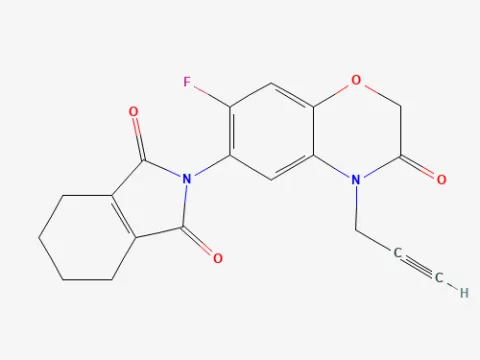
Flumioxazin
Flumioxazin is a member of the N-phenylphthalimide chemical class, functioning primarily as a contact and residual soil-applied herbicide.
What the section contains
Flumioxazin
Its primary mode of action is the inhibition of the protoporphyrinogen oxidase (PPO) enzyme, which is vital for the chlorophyll biosynthesis pathway in plants.
The accumulation of porphyrins, caused by this inhibition, results in rapid lipid peroxidation of cell membranes when exposed to sunlight.
This biochemical process causes irreversible damage to plant cells, leading to necrosis and rapid death of weed seedlings shortly after emergence.
The herbicide remains active in the soil surface layer, providing a residual effect that prevents subsequent flushes of weeds from germinating.
Flumioxazin is highly effective against a wide range of broadleaf weeds, including common lambsquarter, pigweed, ragweed, and various smartweed species.
It is specifically valued for its ability to control weed biotypes that have developed resistance to other herbicide modes of action, such as ALS inhibitors.
The compound is widely used in crops such as soybeans, corn, peanuts, and orchards, where early-season weed competition management is crucial.
Although it does not provide effective control of established perennial weeds, it is an excellent tool for managing annual broadleaf weeds starting from seeds.
Visible symptoms, including yellowing and tissue collapse, appear quickly, often within a few days under favourable light and moisture conditions.
Application rates typically range from 60 to 150 grams of active ingredient per hectare, depending on soil texture, organic matter content, and target species.
Optimal timing is pre-emergence, meaning the product is applied after planting but before the crop emerges from the soil.
A well-prepared, fine-textured seedbed is essential to ensure uniform coverage and consistent soil activity of the active ingredient.
Rainfall or irrigation shortly after application is beneficial as it helps to incorporate the herbicide into the upper soil layer where weeds germinate.
When tank-mixing with other products, ensure proper compatibility and adherence to the label recommendations regarding the order of mixing.
Flumioxazin must not be applied to actively growing crop foliage, as it will cause severe leaf burn, stunting, or mortality of the crop.
Mechanical cultivation after application should be minimized to avoid breaking the herbicide barrier, which could allow weeds to emerge from untreated soil.
Crop rotation restrictions must be strictly followed, as residual soil activity can potentially affect the growth of sensitive crops planted in the following season.
Personal protective equipment (PPE) is mandatory during handling and application to prevent dermal contact and inhalation of spray mist.
Avoid application on sandy soils or soils with extremely low organic matter to prevent leaching, which can cause injury to the crop root zone.