
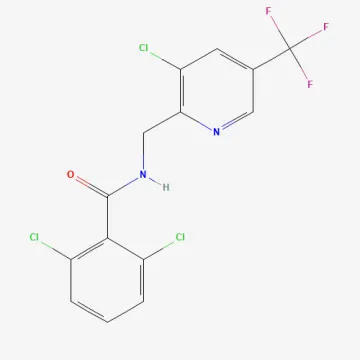
Fluopicolide
Description
Mode of action
Fluopicolide belongs to the chemical class of benzamides (acylaminobenzamides). It is an innovative active ingredient that offers a unique mechanism of action against fungal pathogens from the oomycete class.
The primary principle of its action is the disorganization of the pathogen's cellular structures. The substance specifically targets spectrin-like proteins, which are involved in maintaining the shape and integrity of the fungus's cellular skeleton.
As a result of fluopicolide activity, rapid mycelium fragmentation and disruption of zoospore formation occur. This leads to the cessation of pathogen colony growth within just a few hours after application.
The compound exhibits strong systemic and translaminar properties. It can rapidly penetrate leaf tissues and move through them, protecting not only the treated surface but also untreated parts of the plant and new growth.
Furthermore, fluopicolide effectively suppresses the spore germination process by blocking their mobility in water droplets. This makes it a powerful tool for both prophylactic and curative crop protection.
What it targets
The active ingredient is highly specialized for controlling oomycetes, including a wide range of species causing late blight and downy mildew on various crops.
The preparation is most effective against Phytophthora infestans, which causes late blight in potatoes and tomatoes, and Plasmopara viticola, the causal agent of grapevine downy mildew.
It is also actively used against downy mildew on greenhouse and open-field vegetable crops, including cucumbers, onions, and other cruciferous plants.
The substance demonstrates high efficacy against pathogens that have developed resistance to phenylamides and other fungicide groups, making it a critical component of anti-resistance strategies.
- Potato late blight
- Grapevine downy mildew
- Downy mildew of vegetables
Rates and timing
Application rates for the product depend on the severity of the disease and the biological characteristics of the crop. Usually, the spray solution is prepared based on the leaf surface area to be treated.
The timing of treatments should correspond to periods of high pathogen activity or predicted primary infection risks, which often coincide with humid and warm weather conditions.
For maximum efficacy, prophylactic application is recommended before visible symptoms of infection appear in the field.
The interval between treatments during the plant's intensive growth period usually ranges from 7 to 12 days, depending on the intensity of the infection pressure.
A crucial aspect is the thoroughness of covering the leaf blades with the spray solution, as uniform distribution guarantees a reliable protective barrier for the plant.
Restrictions
Fluopicolide belongs to a group of fungicides that require strict rotation with products from other chemical classes to prevent the development of resistance.
It is not recommended to exceed the maximum number of applications per season specified in the regulations for specific products based on this active ingredient.
When working with the substance, standard safety measures must be followed: use personal protective equipment for skin, eyes, and respiratory organs during the preparation of tank mixes.
The product may exhibit toxicity to some aquatic species, so it is necessary to prevent any runoff of the spray solution into water bodies or drainage systems.
Disposal of packaging and fungicide residues must be carried out in strict accordance with environmental regulations and national legislation on pesticide handling.
Status in the European Union
Approved in the EU
- CAS number
- 239110-15-7
- Approved from
- 01.06.2010
- Approval until
- 31.08.2026
- ADI
- 0.08 mg/kg bw/day
- ARfD
- 0.18 mg/kg bw
- AOEL
- 0.05 mg/kg bw/day
EU status is for reference only and does not replace national registration in your country.