
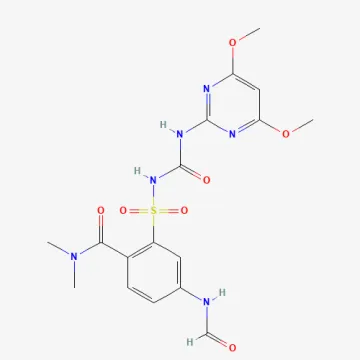
Foramsulfuron
Description
Mode of action
Foramsulfuron belongs to the sulfonylurea chemical class. It is a systemic active ingredient that penetrates the plant through leaves and stems, quickly translocating via the phloem and xylem to the active growth points of weeds.
Its mechanism of action is based on the inhibition of the acetolactate synthase (ALS) enzyme. This enzyme is critical for the synthesis of essential branched-chain amino acids, such as valine, leucine, and isoleucine.
As a result of suppressed amino acid synthesis, cell division in weed meristems stops almost immediately after application. Weed growth ceases within a few hours of treatment.
Complete weed death occurs within 1–3 weeks, depending on weather conditions. Initially, chlorosis of young leaves is observed, followed by necrosis and the gradual die-off of all weed parts.
An important feature is that foramsulfuron is often used in complex formulations with safeners (antidotes), which allow crop plants to effectively metabolize the herbicide, ensuring high selectivity.
What it targets
This substance is primarily used for protecting maize crops against a wide spectrum of annual and perennial grasses, as well as many broad-leaved weeds.
Foramsulfuron demonstrates high efficacy against such aggressive weeds as couch grass, barnyard grass, foxtail species, johnsongrass, as well as pigweed and knotweed.
The product's efficacy is significantly higher when weeds are treated in their early growth stages, when they are actively growing and have a well-developed leaf surface.
The product effectively suppresses the regrowth of perennial weeds from rhizomes, which is critical for obtaining weed-free fields.
- Barnyard grass (Echinochloa crus-galli)
- Couch grass (Elymus repens)
- Foxtail species (Setaria spp.)
- Redroot pigweed (Amaranthus retroflexus)
Rates and timing
Application rates for foramsulfuron vary depending on the specific formulation, the weed growth stage, and the level of field infestation.
The standard application time is during the active vegetative growth phase of maize, typically between the 2nd and 6th leaf stages. At this time, weeds are most susceptible to systemic action.
The application requires strict adherence to temperature guidelines. The optimal effect is achieved at ambient temperatures between +15°C and +25°C.
It is important to ensure high-quality coverage of the leaf surface with the working solution, as foramsulfuron is a foliar herbicide with minimal soil activity.
In dry conditions, efficacy may decrease, therefore it is recommended to increase the water volume or use auxiliary surfactants.
Restrictions
It is not recommended to treat crops that are under stress due to frost, drought, pest attacks, or nutrient deficiencies.
Foramsulfuron has high selectivity, but temporary yellowing of maize leaves may occur if dosage or timing guidelines are violated.
The use of the product in tank mixes with organophosphate insecticides is prohibited, as this may lead to crop damage due to the blockage of safener protection.
Avoid spray drift onto neighboring crops sensitive to sulfonylurea exposure, especially sugar beets, sunflowers, and vegetable crops.
After harvesting maize treated with this herbicide, there are usually no crop rotation restrictions; however, intervals should be considered when applying under specific soil and climatic conditions.
Status in the European Union
Approved in the EU
- CAS number
- 173159-57-4
- Approved from
- 01.06.2020
- Approval until
- 31.05.2035
- ADI
- 0.25 mg/kg bw/day
- ARfD
- Not appl.
- AOEL
- 0.1 mg/kg bw/day
EU status is for reference only and does not replace national registration in your country.