

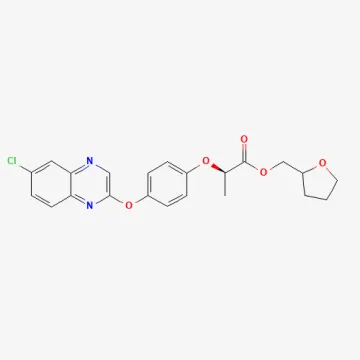
Active ingredient
Especially harmful
Quizalofop-P-tefuryl
Description
Mode of action
Quizalofop-P-tefuryl is a systemic selective herbicide belonging to the aryloxyphenoxypropionate chemical class. It is widely used in agriculture for the post-emergence control of both annual and perennial grass weeds in various broad-leaved crops.
The mode of action involves the inhibition of the enzyme acetyl-CoA carboxylase (ACCase). By blocking this enzyme, the plant cannot synthesize the fatty acids required for membrane production and growth, leading to rapid cessation of biological activity.
Once applied, the substance is rapidly absorbed by the leaves and translocated through the phloem to the meristematic tissues and root systems. This systemic activity is crucial for effectively killing the rhizomes of perennial grasses like couch grass.
Visible symptoms, including chlorosis and necrosis of the growing points, typically appear within a week, while complete death of the weed occurs in approximately 10 to 20 days, depending on environmental variables.
Due to its high selectivity, it offers an effective solution for farmers to manage grass infestations without harming the primary crop, provided that application timing and dosages are adhered to correctly.
What it targets
This active ingredient is highly effective against a variety of problematic monocotyledonous weeds, including:
- Elymus repens (Couch grass)
- Setaria spp. (Foxtail)
- Echinochloa crus-galli (Barnyard grass)
- Avena fatua (Wild oat)
- Volunteer cereals
Rates and timing
Application rates depend on the growth stage and density of the weed population. For optimal results, treat annual grasses at the 2–4 leaf stage, while perennial grasses should be treated when they reach a height of 10–15 cm.
Ensure a thorough coverage of the foliage during spraying. The use of adjuvants or surfactants is highly recommended to improve the penetration of the active ingredient through the leaf cuticle, especially under less-than-ideal environmental conditions.
Restrictions
Avoid application if weeds are under stress due to drought, low temperatures, or insect damage, as this significantly reduces the uptake and efficacy of the herbicide. Optimal efficacy is observed when weeds are actively growing.
Be cautious when mixing with other herbicides. Antagonism may occur when quizalofop-P-tefuryl is tank-mixed with broad-leaved herbicides, potentially leading to reduced control. Always consult local guidelines regarding chemical compatibility before mixing.
Content graph
Connections · Quizalofop-P-tefuryl
Most often together:
Marketplace
Products · 24

Pantera
Кемарк КФТ, Угорщи (на замовлення Кемтура Корпорейшн, США)на
Herbicides
1
0
·
3.4K
27 offers
8.94 €per 1 l
Buy


Antizlak
Jiangsu Good Harvest-Wayen Agrochemical Co., Ltd.
Herbicides
0
0
·
1K
2 offers
20.63 €per 1 l
Buy


Grinfort CF 40, KE
«Нанджин Ессенс Файн-Кемікал Ко. Лтд» (Китай)
Herbicides
0
0
·
67
1 offer
5.24 €per 1 l
Buy

Panthera c.e.
Кемарк КФТ, Угорщи (на замовлення Кемтура Корпорейшн, США)на
Herbicides
0
0
·
64
3 offers
26.1 €per 1 l
Buy


Grinfort CF 40
«Нанджин Ессенс Файн-Кемікал Ко. Лтд» (Китай)
Herbicides
0
0
·
47
1 offer
6.6 €per 1 l
Buy


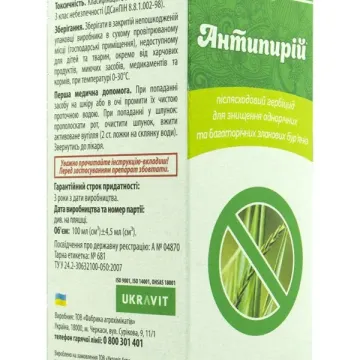
ANTIPRYI, KE
ТОВ «Фабрика агрохімікатів», Черкаси, Україна
Herbicides
0
0
·
27
1 offer
18.4 €per 1 l
Buy


Tröl, EC, (ADG 1/14)
Три Дельта Компані Інтернешнл, Гонконг, Китай.
Herbicides
0
0
·
41
No offers
—
Details

Griñfort CF 40, EC (Halisulfop-p-tefuryl, 40 g/l)
«Нанджин Ессенс Файн-Кемікал Ко. Лтд» (Китай)
Herbicides
0
0
·
40
No offers
—
Details
