

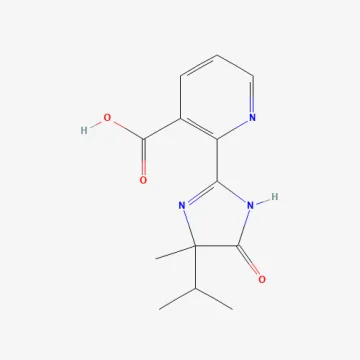
Description
Mode of action
Imazapyr belongs to the chemical class of imidazolinones. It is a systemic herbicide that inhibits the enzyme acetolactate synthase (ALS) in susceptible plants.
The inhibition of this enzyme leads to the cessation of the biosynthesis of essential amino acids such as valine, leucine, and isoleucine, resulting in the interruption of protein synthesis and cell division.
The active ingredient is rapidly absorbed by the foliage, stems, and root systems of target weeds and translocated through the phloem and xylem to the meristematic tissues.
Initial visual signs of plant stress, such as chlorosis of young leaves and growth stunting, typically appear within several days after application.
Complete mortality of weeds, particularly perennial species with developed root systems, is achieved several weeks following the treatment.
What it targets
The herbicide exhibits high efficacy against a broad spectrum of annual and perennial grasses, as well as broad-leaved weed species.
Imazapyr is particularly valued for its effectiveness in controlling aggressive perennial weeds, including rhizomatous and deep-rooted species.
It successfully suppresses various difficult-to-control plants such as quackgrass, thistles, ragweed, and a wide array of woody brush and shrubs.
Due to its soil activity, the compound also provides residual control by suppressing the germination of weed seeds for an extended period.
- High efficacy against woody and shrub vegetation.
- Broad-spectrum control of annual weeds.
- Long-term residual action on non-cropped lands.
Rates and timing
Imazapyr is primarily applied on non-agricultural lands, such as railway rights-of-way, utility corridors, power line sites, and industrial storage areas.
Application rates vary depending on the specific weed species composition, the growth stage of the plants, and the environmental conditions of the treated area.
The optimal timing for application is during the period of active weed growth, when the plant biomass is most susceptible to herbicide uptake and translocation.
When targeting woody vegetation, applications are typically conducted during the active sap flow phase to ensure effective systemic movement of the herbicide.
Ensuring uniform coverage of the treated surface is critical for achieving the highest level of herbicide performance and consistency.
Restrictions
Due to its significant soil activity and extended residual half-life, Imazapyr is not recommended for use on land intended for future crop cultivation.
Strict precautions must be taken to prevent herbicide drift onto adjacent crops, desirable trees, or water bodies to avoid unintended environmental damage.
Personnel handling the product must utilize appropriate personal protective equipment (PPE) for skin, respiratory, and eye protection at all times.
Livestock grazing is prohibited on areas treated with this herbicide for a mandated period following the application to ensure safety.
Disposal of empty containers and leftover spray solutions must comply with local environmental regulations and safety protocols for chemical waste.
Content graph
Connections · Imazapyr
Most often together:
Marketplace
Products · 65


Euro-3315
Scientific-Production Company "Kvadrat", LLC
Herbicides
0
0
·
55
8 offers
12.34 €per 1 l
Buy

VITALIGHT, RK
ТОВ «Фабрика агрохімікатів», Черкаси, Україна
Herbicides
0
0
·
54
3 offers
11.17 €per 1 l
Buy


Madera 48 RC
Фадер Альянс Лтд., Великобританія (Fader Alliance Ltd., England) на заводах Нідерландів, Польщі
Herbicides
0
0
·
48
8 offers
13.9 €per 1 l
Buy


IMPERIAL, RC
Nantong Pesti Agrochemical Limited Company, Nantong, КНР
Herbicides
0
0
·
45
3 offers
1.43 €per 1 l
Buy


Capreo Protect
Hangzhou Ruijiang Chemical Co., Ltd.
Herbicides
0
0
·
43
2 offers
371.65 €per 1 l
Buy

Genesis, RK
ТОВ «Фабрика агрохімікатів», Черкаси, Україна
Herbicides
0
0
·
43
1 offer
10.36 €per pack
Buy


Kaptor, RK, (Imazamox, 33 g/l + Imazapir, 15 g/l)
BASF Agro B.V.
Herbicides
0
0
·
36
2 offers
30.95 €per 1 l
Buy


Capreo Protect, RK (imazapir, 33 g/l + imazamox, 15 g/l)
Hangzhou Ruijiang Chemical Co., Ltd.
Herbicides
0
0
·
26
3 offers
10.22 €per 1 l
Buy


Impresa, RK (imazamox, 33 g/l + imazapir, 15 g/l)
Hangzhou Ruijiang Chemical Co., Ltd.
Herbicides
0
0
·
19
2 offers
10.06 €per 1 l
Buy


Grinfort Light, RK (imazamox, 33 g/l + imazapir, 15 g/l)
АгроМаксі, ТОВ
Herbicides
0
0
·
39
No offers
—
Details


Evrail, RK (imazapir, 33 g/l + imazamox, 15 g/l)
Hangzhou Ruijiang Chemical Co., Ltd, КНР
Herbicides
0
0
·
35
No offers
—
Details

