
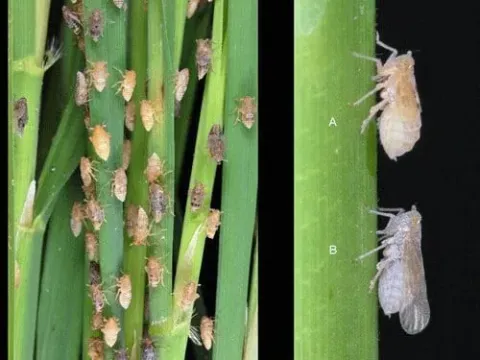
Brown planthopper
Nilaparvata oryzae
The brown planthopper (Nilaparvata lugens) is a significant pest of rice, belonging to the Delphacidae family. These insects measure about 3–5 mm and exist in two distinct morphs: macropterous (long-winged) adults capable of migration, and brachypterous (short-winged) adults.
What the section contains
Brown planthopper
The coloration of adults typically ranges from light to dark brown. A key identifying characteristic is the presence of two robust spurs on the hind tibiae, a morphological feature distinguishing them from other sap-sucking insects in paddy fields.
Nymphs develop through five distinct instars. They resemble miniature versions of adults but lack functional wings. Their color varies from whitish to brownish, allowing them to blend into the base of the rice stems where they feed.
These insects are highly secretive, preferring the microclimate near the base of rice plants. They stay close to the water level where high humidity is maintained, which is essential for their survival and egg incubation.
The population exhibits a high reproductive rate. A single generation can complete its cycle in less than a month under optimal tropical conditions, allowing for exponential population growth in short periods.
Rice is the primary host for the brown planthopper. The pest utilizes its piercing-sucking mouthparts to extract sap directly from the phloem vessels, causing physiological stress and nutrient depletion in the rice plant.
Beyond direct damage, the planthopper is a vector for severe viral diseases, most notably the rice ragged stunt virus and the grassy stunt virus, which prevent plants from producing harvestable grain.
Massive infestations lead to 'hopperburn', a condition where large patches of rice plants turn yellow, then brown, and finally wither. This occurs because the combined feeding pressure destroys the plant's hydraulic system.
Damage is most critical during the tillering and booting stages. Severe infestation during these periods hinders flower development and results in poor grain filling or total crop failure.
The economic impact is profound, as the infestation can spread rapidly across entire farms if left unmanaged, often leading to complete loss of the affected paddies.
The population dynamics are heavily influenced by temperature and humidity. Brown planthoppers thrive in warm, humid conditions, typically between 25°C and 30°C, with high rainfall patterns.
Long-winged adults are adept at long-distance migration, often traveling with wind currents. This allows them to recolonize fields from significant distances, leading to sudden and unexpected outbreaks.
In tropical climates, the insect breeds continuously throughout the year. In more temperate zones, it may overwinter in the egg or nymphal stage within crop debris or on alternate host plants.
The peak season usually aligns with the intensive vegetative growth phase of rice crops. Denser plant canopies create the high-humidity, low-light environment that these insects prefer.
Farmers often observe the highest densities during the mid-to-late crop season, when the canopy is dense enough to protect the insect colony from predators and direct heat.
The initial signs of infestation are often subtle, characterized by small, yellowing patches in the field that gradually expand. Plants may look as if they are suffering from drought despite adequate water supply.
Sooty mold growth is a diagnostic sign. As the planthoppers feed, they excrete excess sugars (honeydew), which coats the stems and promotes the growth of black, fuzzy fungal colonies.
If you disturb the rice canopy, you will see a visible 'jump' of small insects as they escape into the lower parts of the plant or onto the water surface.
- Presence of honeydew and black sooty mold on stems
- Yellowing and wilting of plants in patches (hopperburn)
- Disturbed plants show sudden movement of tiny brown insects
- Stunted plant height and reduced tiller numbers
- Deformed or yellowish leaves due to virus transmission
In later stages, the plants collapse, and the field acquires a scorched appearance, indicating that the vascular tissues have been severely compromised by prolonged sap-sucking.
The most effective strategy is the use of resistant rice cultivars, which have been bred to withstand planthopper feeding and resist the transmission of associated viruses.
Water management plays a crucial role. Manipulating water levels in the paddy, specifically intermittent drying, can reduce the micro-environment humidity and increase mortality among the nymph populations.
Biological control agents, including various species of spiders, mirid bugs, and parasitic wasps, are essential for maintaining balance and should be preserved through careful pesticide management.
Chemical control should be applied strictly based on economic threshold levels. Farmers are encouraged to use selective, systemic insecticides that minimize harm to natural predatory populations.
Avoid excessive use of nitrogenous fertilizers, as high nitrogen promotes lush, succulent plant growth, which significantly increases the planthopper's reproductive rate and population size.