
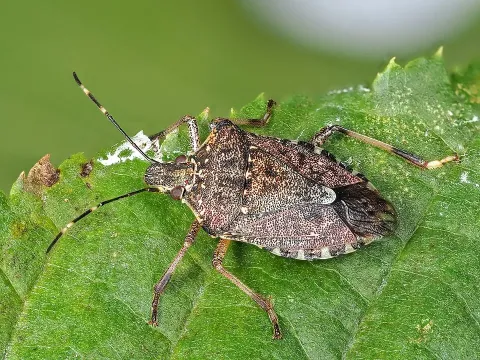
Brown marmorated stink bug
Halyomorpha mista
The brown marmorated stink bug (Halyomorpha halys) belongs to the Pentatomidae family. Adults are shield-shaped, measuring approximately 12–17 mm in length, and possess a mottled brownish-grey appearance.
What the section contains
Brown marmorated stink bug
Key identification features include distinct white banding on the antennae and alternating light and dark markings along the abdominal edges, known as the connexivum.
The eggs are laid in clusters on the underside of leaves and are characterized by their barrel-like shape, transitioning from pale yellow to reddish as they mature.
Nymphs undergo five instars, progressively increasing in size and transitioning from an orange-black pattern to a darker color that mimics the adult coloration.
The species is distinguished from native stink bug species by its specific body morphology and its tendency to aggregate in very high numbers on host plants.
This species is a highly polyphagous pest capable of damaging over 300 plant species, including fruit trees like apples, peaches, and pears, as well as hazelnuts.
Damage occurs when the bug pierces plant tissues with its proboscis and injects enzymes, which degrade the plant cells and cause localized tissue death or deformation.
In fruits, this feeding behavior results in pitting, scarring, and the development of corky, necrotic spots under the skin, rendering the produce unmarketable.
Vegetable crops such as tomatoes, peppers, and beans suffer from similar feeding damage, leading to stunted growth, internal fruit decay, and reduced yields.
Corn and soybean crops are also vulnerable, as the bugs feed on developing kernels, which facilitates the entry of pathogens and reduces grain quality.
Adults emerge from their overwintering sites in early spring, typically once temperatures remain consistently above 10-12°C, to begin feeding on available hosts.
During the summer months, the population grows rapidly as females lay multiple egg batches, resulting in one to three generations per year depending on the climate.
The peak of activity occurs in late summer and early autumn, as the bugs feed heavily to accumulate energy reserves required for the overwintering period.
As temperatures drop in October, adults migrate toward human-made structures, homes, and warehouses to seek shelter for winter diapause.
The survival rate during winter is highly dependent on the severity of the cold, with milder winters leading to significantly higher spring populations.
Visible signs of infestation include small puncture wounds on the fruit surface, often surrounded by halos of discoloration or necrotic spots.
Internally, affected fruits exhibit discolored, woody, and spongy tissue, which makes them taste unpalatable and ruins their commercial appearance.
Young shoots and foliage may show signs of wilting or chlorosis as a direct result of sap extraction by the bugs during their feeding sessions.
The presence of mass aggregations of nymphs on the undersides of leaves or on stems is a reliable indicator that the colony is actively feeding in the area.
The emission of a pungent, unpleasant odor when the insects are disturbed serves as a clear sensory signal of their presence in the orchard or field.
- Deployment of pheromone-baited traps for population monitoring and mass trapping of adults.
- Mechanical removal and disposal of egg clusters and aggregations of nymphs on small-scale plots.
- Application of registered insecticides during the early nymphal stages to prevent significant fruit damage.
- Implementation of exclusion netting over orchards or sensitive vegetable crops to physically block the pests.
- Sanitation practices, including the removal of debris and control of alternate weed hosts to reduce overwintering sites.