
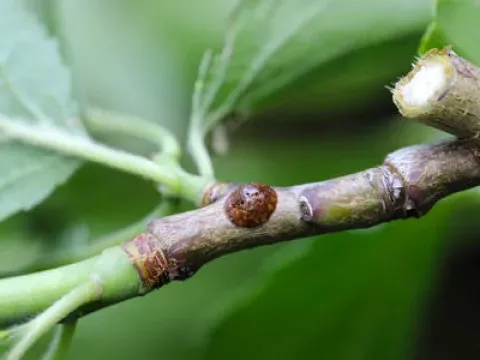
Brown soft scale
Lecanium berberidis
The brown soft scale (Lecanium berberidis) is a member of the Coccidae family. The adult female has a convex, hemispherical, dark brown body, reaching up to 6 mm in length.
What the section contains
Brown soft scale
Unlike armored scales, the soft scale does not have a separate secreted shell; its hardened body wall serves as a protective cover for eggs and the female itself.
The first-instar nymphs, known as crawlers, are light-colored, oval, and highly mobile, allowing them to disperse across the host plant or to nearby vegetation.
This species primarily reproduces parthenogenetically, meaning males are rarely observed, which allows the population to increase rapidly under favorable conditions.
Once egg-laying is complete, the female's body becomes a dry, hardened case that protects the eggs until they hatch in mid-summer.
The pest primarily targets barberry bushes, but it is highly polyphagous and infests a wide range of woody plants in home gardens and nurseries.
Common hosts include ornamental shrubs like spirea, cotoneaster, and hawthorn, as well as fruit trees such as apple, pear, and plum varieties.
The insects feed by inserting their piercing-sucking mouthparts into the phloem of young branches and leaves, depleting the plant's essential nutrients.
Severe infestations can lead to significant stunting of growth, branch dieback, and an overall reduction in the plant's health and vigor.
The excretion of large amounts of honeydew promotes the growth of sooty mold, which blocks sunlight and inhibits photosynthesis on the leaf surface.
The life cycle typically consists of one generation per year, with second-instar nymphs serving as the primary overwintering stage on the host bark.
As temperatures rise in the spring, the nymphs resume feeding and develop into adult females, which become increasingly prominent and convex.
Egg-laying usually occurs in late May through June, marking the period when females reach their maximum size before they expire.
Crawlers emerge in July, which is the most vulnerable stage in the life cycle and the ideal window for applying control measures.
By autumn, the newly hatched nymphs settle into crevices and sheltered areas on the twigs to enter diapause and survive the winter months.
The most obvious symptom is the presence of small, dark brown, dome-shaped bumps on the twigs that cannot be easily brushed off by hand.
Leaves may show signs of chlorosis, yellowing, or premature drop, while new growth often appears twisted or fails to develop properly.
Sticky honeydew on the leaves and branches is a clear indicator that a colony is active and currently feeding on the plant's sap.
The development of a black, dusty coating (sooty mold) on foliage confirms that the pest population is well-established and has been present for some time.
- Distorted or stunted branch tips.
- Reduced vigor and stunted overall growth.
- Loss of foliage color and aesthetic value.
Effective management requires a combination of physical removal, such as pruning infested branches, and timely chemical applications.
Systemic insecticides are most effective when applied during the crawler emergence phase in mid-summer, as the young insects are more susceptible.
Early spring applications of horticultural oils can help suffocate overwintering nymphs before they become active and start feeding in the new season.
Regular monitoring of susceptible shrubs is crucial; detecting the infestation early allows for targeted treatments rather than broad-spectrum spraying.
Promoting general plant health through proper irrigation and fertilization improves the host's natural ability to withstand and recover from pest attacks.