
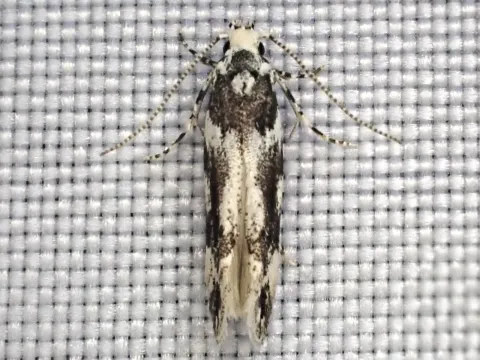
Bud moth
Stenolechia albiceps
Stenolechia albiceps, commonly known as a type of bud moth, belongs to the family Gelechiidae. This small moth is often overlooked due to its cryptic behavior and camouflage.
What the section contains
Bud moth
The adult moth features narrow forewings with a brownish-grey pattern and a distinct pale head, measuring approximately 9-11 mm in wingspan.
Larvae undergo several developmental stages, shifting from a light yellowish hue to a reddish-brown color as they mature and prepare for pupation.
Pupation occurs within dense, protective cocoons hidden in bark crevices or near the base of buds, shielding the insect from predators and weather.
The biological cycle is strictly adapted to the phenology of fruit trees, ensuring the larvae emerge precisely when buds start to swell in spring.
This pest primarily infests pome fruits, particularly apple trees, though it may occasionally attack pear and stone fruit species in commercial orchards.
The larvae are specialized bud feeders. They bore into the buds, consuming the tender inner tissues, which effectively destroys the growing points.
Significant economic loss is associated with the destruction of fruit buds, as each damaged bud represents a direct reduction in the potential harvest.
Young shoots can also be targeted once the buds are exhausted, leading to stunted growth, distorted foliage, and poor structural development of branches.
Repeated infestation over several seasons can severely stress the trees, making them more susceptible to opportunistic fungal infections and environmental stress.
The species overwinters as mature larvae encased in cocoons within the bark of host trees, where they remain dormant during the coldest months.
Emergence occurs early in the spring, synchronized with the bud-break phase of apple trees, which is the most critical period for population impact.
Adult moths are typically active during the summer months, during which they mate and deposit eggs on the undersides of leaves or near bud scales.
Depending on the climatic conditions and regional temperatures, the moth can complete one or two generations within a single growing season.
Monitoring the spring emergence is essential, as the larvae move quickly from their overwintering sites to the developing buds to begin feeding.
One of the most obvious signs of infestation is the presence of frass (excrement) around the bud scales, often clumped together with fine silk threads.
Affected buds appear hollowed out, brownish, and fail to open properly during the spring growth flush, remaining as dry remnants on the branches.
Webbing between buds or adjacent leaves serves as a clear indicator of larval activity, as the moth uses silk to anchor its feeding site.
In cases of severe infestation, the foliage may appear sparse, and the tree may show a visible lack of expected spring vigor in specific zones.
- hollowed-out buds;
- silk webbing on tips of branches;
- accumulation of larval frass on bark;
- premature drying of budding shoots.
Chemical control involving systemic insecticides is most effective when applied at the green tip or early bud burst stage before larvae enter the buds.
Cultural practices such as scraping off rough bark during the winter can remove overwintering cocoons and significantly reduce the pest pressure.
Encouraging natural predators, including various species of parasitic wasps and predatory mites, helps maintain a balance within the orchard ecosystem.
Pheromone traps are highly recommended for monitoring adult flight activity, allowing growers to time their intervention precisely for maximum impact.
Regular orchard inspection and the prompt removal of heavily infested shoots can prevent the localized spread of the moth throughout the fruit tree rows.