
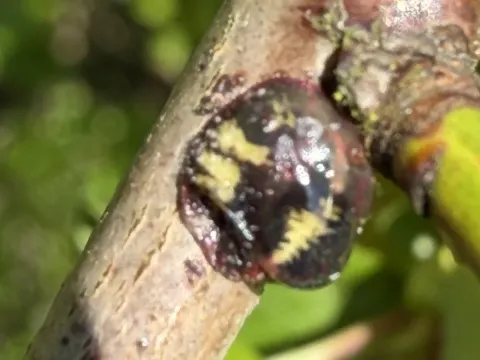
Brown scale
Lecanium capreae
The brown scale (Lecanium capreae) is a member of the Coccidae family, commonly found in orchards and gardens. The adult female is characterized by a hemispherical, brown, and highly convex body, which can grow up to 6 mm in length.
What the section contains
Brown scale
Unlike armored scale insects, the brown scale's protective shield is formed by its own chitinized dorsal integument. This shell is firmly attached to the plant surface, providing robust protection against environmental factors and many predators.
The males of the species are rarely seen; they are smaller, winged, and do not feed, serving primarily for reproductive purposes. The primary dispersal stage is the first-instar nymph, often called a crawler, which is extremely mobile and small.
Overwintering occurs in the second-instar nymph stage. At this time, they resemble small, flat, brown scales that blend into the bark of twigs and small branches, remaining largely undetected until the spring warming period begins.
The species completes one generation per year. As temperatures rise in early spring, the nymphs resume feeding on plant sap, rapidly increasing in size and eventually molting into the stationary, egg-laying adult form.
This pest is highly polyphagous, meaning it feeds on a wide range of plant hosts. It frequently attacks fruit trees such as apple, pear, plum, cherry, apricot, and peach, causing significant economic damage.
Beyond fruit production, it is a major issue for ornamental shrubs and trees including hawthorn, linden, hazel, willow, and various species of ornamental acacia. It can also cause severe infestation in berry patches like currants.
Feeding is performed by piercing the plant tissue and extracting phloem sap. This constant depletion of nutrients leads to stunted growth, wilting, premature leaf drop, and a general decline in the plant's overall vitality.
Severe infestations can cause branch dieback and significantly reduce the cold hardiness of the host plant. Trees weakened by the scale are also more susceptible to opportunistic diseases and secondary pest invasions.
Fruit yield is negatively affected by both the reduced vigor of the tree and the physical presence of the scale. Infested fruit may be smaller, less sweet, and lose their marketability due to the presence of sooty mold.
The lifecycle begins in early spring when overwintered nymphs relocate from the trunk to young shoots and buds. Peak growth and maturation of the females occur simultaneously with the flowering period of fruit crops.
Egg-laying begins in late May or early June. A single female can produce up to 2,000 eggs, which are safely tucked beneath her body. The female dies shortly after, and her body serves as a protective dome for the emerging nymphs.
The crawler stage (first-instar nymphs) emerges during the mid-summer period, typically in June or July. This is the most active phase for the insect and the most effective window for intervention.
Throughout the summer, the nymphs settle on the underside of leaves to feed and grow. This feeding continues until the approach of autumn, when the nymphs migrate back to the woody parts of the tree to prepare for the upcoming winter.
By late autumn, the nymphs have firmly attached themselves to the bark. They enter a state of dormancy and remain on the branches throughout the winter months, awaiting the onset of spring to repeat their cycle.
The most visible sign of infestation is the appearance of small, brown, convex growths on the twigs and branches, which look like small blisters or hardened resin droplets.
The presence of sticky honeydew on leaves and branches is a classic indicator of scale insect activity. This sugary substance is secreted by the scales as they process the plant sap.
The honeydew provides a perfect substrate for the growth of sooty mold, a black fungus that covers leaves and bark. This blocks sunlight and prevents the plant from performing photosynthesis efficiently.
Ant activity is another strong hint; ants are often found tending to the scale colonies to harvest the honeydew, effectively protecting the pests from natural predators such as ladybugs and lacewings.
In winter, after the leaves have fallen, the presence of empty, desiccated female scales on the bark confirms a previous infestation and indicates that the tree will likely face a new generation next season.
Managing the brown scale requires a strategy that combines physical sanitation with targeted chemical applications during the most vulnerable phases of the insect's life cycle.
Physical control involves pruning and destroying heavily infested branches, especially during the dormant season, which helps significantly reduce the overwintering population.
Chemical control is most successful during the crawler stage (June/July) when the young nymphs are not yet protected by the hardened waxy shell. Systemic insecticides are generally the preferred method.
Dormant sprays, such as horticultural oils, can be applied in early spring to smother the overwintering nymphs. This method is effective if the oil coating is applied thoroughly to all bark surfaces.
- Prune and destroy heavily infested branches.
- Apply systemic insecticides during the crawler emergence (June/July).
- Control ant populations to encourage natural predator activity.
- Utilize horticultural dormant oils in late winter to suppress early populations.