
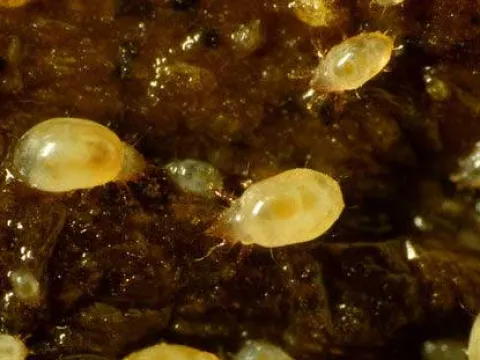
Bulb mite
Rhizoglyphus engeli
The bulb mite (Rhizoglyphus engeli) is a significant soil-dwelling pest belonging to the Acaridae family and the Acariformes order, commonly impacting stored bulbs and roots.
What the section contains
Bulb mite
These mites are microscopic, typically measuring 0.5 to 0.7 mm in length, with a translucent, yellowish-white body and reddish-brown legs.
Their life cycle consists of the egg, larva, protonymph, deutonymph, and adult stages; they can also enter a survival stage known as a hypopus during environmental stress.
Rhizoglyphus engeli thrives in high-humidity environments and moderate temperatures, making greenhouses and poorly ventilated storage facilities ideal breeding grounds.
The population can explode under favorable conditions, completing multiple life cycles in a single season, leading to rapid and widespread crop destruction.
The pest targets a vast array of plant species, particularly bulbous ornamentals like tulips, lilies, and hyacinths, as well as vegetables such as onions and garlic.
Mites penetrate the bulb through the basal plate or existing wounds, feeding on internal tissues and creating tunnels that disrupt nutrient transport.
Feeding damage often facilitates secondary fungal and bacterial infections, which accelerate the decomposition and rot of the infected plant material.
Field-grown plants show stunted growth, chlorosis, and wilting, often failing to reach maturity due to the severe destruction of the root and basal tissue.
The economic impact is particularly devastating in storage, where entire batches of bulbs can be rendered non-viable within a matter of weeks.
A tell-tale sign of a bulb mite infestation is the presence of fine, brown, powdery residue or frass located at the base of the bulb.
Internally, infested bulbs show irregular hollows and excavated tissue, which may be filled with clusters of mites and their eggs.
Severe infestations often result in the total destruction of the root system, causing the plant to be easily pulled from the soil with no attached roots.
Plants display leaf yellowing, distorted growth, and often fail to produce viable flower spikes, or the buds collapse before blooming.
In humid storage conditions, the presence of these mites is often accompanied by the distinct, damp odor of rotting organic matter caused by decay organisms.
Effective management requires strict environmental control during storage, keeping temperatures below 5°C to arrest the reproductive cycle of the mites.
Pre-planting treatments involving soaking bulbs in approved acaricide solutions are essential to eradicate dormant populations hiding within the tissue.
Good agricultural practices, such as maintaining proper crop rotation and ensuring soil drainage, are crucial for reducing the risk of re-infestation.
- Rigorous inspection and culling of infested planting material.
- Sanitization of storage facilities and gardening equipment.
- Judicious use of systemic and contact acaricides.
For greenhouse operations, soil steam sterilization and maintaining consistent air circulation are effective strategies for limiting the spread of the pest.