
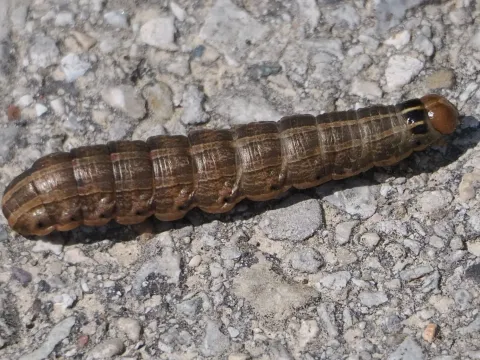
Bronze cutworm
Nephelodes violans
The bronze cutworm (Nephelodes violans) belongs to the Noctuidae family, order Lepidoptera. The adult is a medium-sized moth with a wingspan of up to 40 mm, characterized by its bronze-brown or dark-colored forewings.
What the section contains
Bronze cutworm
Larvae of this species go through several developmental stages, reaching 40–50 mm in length. Their body is typically smooth with longitudinal light stripes on a dark background, aiding in camouflage within the base of host plants.
Pupae usually reside in the soil at a shallow depth. This stage is how the pest successfully overwinters in temperate climates.
The biology of the species is characterized by a single generation per year. Adult activity occurs during the summer, when mating and egg-laying on the leaves of host plants take place.
Larval development occurs primarily at night, as they lead a secretive lifestyle, hiding during the day in thick vegetation or under soil clumps at the base of stems.
The main food sources for bronze cutworm larvae are cereal crops, including corn, wheat, barley, and oats. The pest also actively colonizes natural grasses and pastures.
Young larvae feed on the leaf epidermis, leaving characteristic scraping marks, while older larvae can completely sever stems at the base, leading to plant death.
Mass reproduction of the pest poses a significant danger, as larvae can destroy entire sections of a field in a very short period.
Damage caused by the bronze cutworm is often confused with other cutworm species, so accurate diagnosis requires field inspections during the evening hours.
In addition to direct leaf tissue destruction, damage opens entry points for secondary fungal and bacterial infections, reducing both yield quality and quantity.
The life cycle of the bronze cutworm is closely linked to climatic factors. Moth flight begins in late summer and continues until early autumn, depending on regional temperature patterns.
Eggs are laid by females on plant debris or the soil surface, where they remain until the following spring. Embryonic development concludes with the arrival of stable warm weather.
Mass emergence of larvae in fields is observed in late spring to early summer. During this period, larvae are highly voracious, coinciding with the active growth phase of cereals.
By mid-summer, larvae finish feeding and enter the soil to pupate. Their period of active impact on crops lasts about 4–6 weeks, followed by a dormant phase.
Monitoring pest density should be conducted in May and June using light traps for adults and regular field inspections for larval presence.
An indicator of infestation is the appearance of "lodging" patches in the field, where individual stems are found severed at the base and lying on the ground.
- presence of holes and uneven edges on young cereal leaves;
- larval excrement found in the root zone;
- sudden yellowing and wilting of the central leaf of the plant;
- larvae discovered by digging up soil near damaged stems.
In fields with high pest density, one can often observe "bare" spots where vegetation has been completely consumed by larvae overnight.
Given their nocturnal lifestyle, detecting larvae during the day is difficult without using a flashlight for night-time field surveys.
Agrotechnical methods include proper soil cultivation (discing or plowing), which helps destroy pupation sites and reduce the pest population.
Crop rotation is a crucial control factor, as alternating cereal crops with non-host species disrupts the food chain of the bronze cutworm.
Biological control methods include the use of entomopathogenic products containing Bacillus thuringiensis bacteria, which are effective against young lepidopteran larvae.
Upon reaching the economic threshold of damage, insecticides from the synthetic pyrethroid or organophosphate groups are applied during the evening hours.
Cleaning fields of weed vegetation in the spring deprives young larvae of their primary food source, significantly reducing the risk of them moving to cultivated crops.