
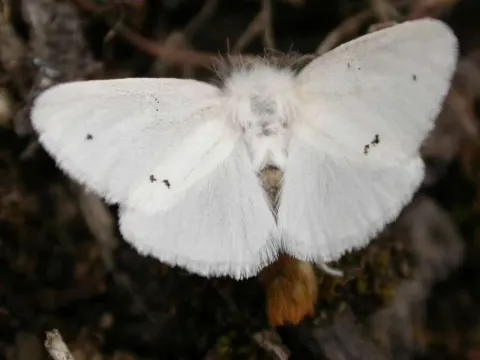
Brown-tail moth
Porthesia
The Brown-tail moth (Euproctis chrysorrhoea) belongs to the Erebidae family. The adult moth is white with a distinctive golden-brown tuft of hair at the end of the female's abdomen, which serves as a visual indicator for identification.
What the section contains
Brown-tail moth
The caterpillars are covered in fine, irritating hairs that contain toxins. Contact with these hairs can cause severe skin irritation, rashes, and respiratory issues in humans, making handling during management tasks potentially hazardous.
The life cycle involves four stages: egg, larva (caterpillar), pupa, and adult. They typically produce one generation per year, and their survival is highly dependent on the success of their overwintering nests.
These pests overwinter in gregarious silk nests constructed from dead leaves tied together with silk. These nests are highly durable and usually found attached to the tips of tree branches, making them easy to spot in winter.
Females lay eggs in large clusters on the underside of leaves, covering them with hair from their abdomen to provide insulation and camouflage from potential predators until the larvae hatch.
Brown-tail moths are polyphagous pests that attack a wide variety of deciduous trees, including apple, pear, plum, cherry, oak, and hawthorn. They are known for causing significant defoliation in orchards and woodlands.
Young larvae feed by skeletonizing the leaves, which causes them to wither. As they mature, they consume entire leaf blades, leading to rapid and severe canopy loss, which can weaken the tree significantly.
Spring feeding is the most damaging phase, as the caterpillars emerge from their winter nests and attack developing buds and early blossoms, directly reducing the tree's potential for fruit production.
Massive infestations can result in the complete defoliation of host trees. This stress forces the tree to expend energy to produce new foliage, which reduces the resources available for fruit ripening and winter hardiness.
Repeated yearly attacks lead to reduced vigor, stunted growth, and increased susceptibility to secondary pathogens and other pests, eventually threatening the long-term survival of the infested trees.
Adult moths are typically active during the summer months, specifically from June to July. They are nocturnal insects, often attracted to light, though they are primarily focused on mating and egg-laying.
Eggs hatch in late summer, and the young larvae begin feeding immediately to store energy for the coming winter. They congregate into their silk nests as temperatures drop in autumn.
Larval emergence in spring usually coincides with the swelling of buds on host plants. This timing is critical, as it aligns the caterpillar's hunger with the tree's most vulnerable phenological stage.
Pupation takes place during late spring or early summer within the canopy, often inside loose, silk-bound leaves. After a short pupal period, the adults emerge to begin the next generation.
Climatic conditions, particularly temperature and humidity levels during the larval feeding period, play a major role in the population dynamics and the severity of the infestation in any given season.
The most reliable sign of a Brown-tail moth infestation is the presence of silk nests, which persist on branches throughout the winter months. They appear as small, brownish clusters of leaves held firmly by webbing.
In spring, the first visible signs are damaged, hollowed-out buds or leaves that appear ragged. Closer inspection often reveals the caterpillars emerging from their nests to forage on fresh growth.
During the peak feeding season, large congregations of caterpillars can be seen resting or feeding in the canopy. Their presence is often accompanied by large amounts of frass (excrement) dropping below the tree.
The presence of cocoons later in the season indicates the transition to the pupal stage. These cocoons are typically located within the foliage and may be less conspicuous than the winter nests.
Symptoms also include the gradual browning of foliage in specific parts of the canopy where the colony is feeding, eventually leading to thin, skeletal branches stripped of their photosynthetic surface.
The primary control method is the physical removal and destruction of winter nests by pruning. Removing these nests before the caterpillars emerge in early spring is highly effective at reducing local populations.
Biological control using Bacillus thuringiensis (Bt) sprays can be highly effective when applied to young larvae. This approach is preferred for minimizing environmental impact and protecting beneficial insects.
Chemical intervention should be considered only when populations exceed economic thresholds. Systemic or contact insecticides must be timed accurately to target the larvae during their most active feeding stages.
Encouraging native bird populations and supporting beneficial arthropods, such as predatory wasps and flies, can help keep caterpillar populations in check through natural predation.
Always wear protective gear—including gloves, long sleeves, and goggles—when handling nests or infested branches to avoid the toxic hairs. If contact occurs, wash the affected area immediately and seek medical advice if an allergic reaction develops.