

Onion fly
Delia antiqua
Description
How to identify
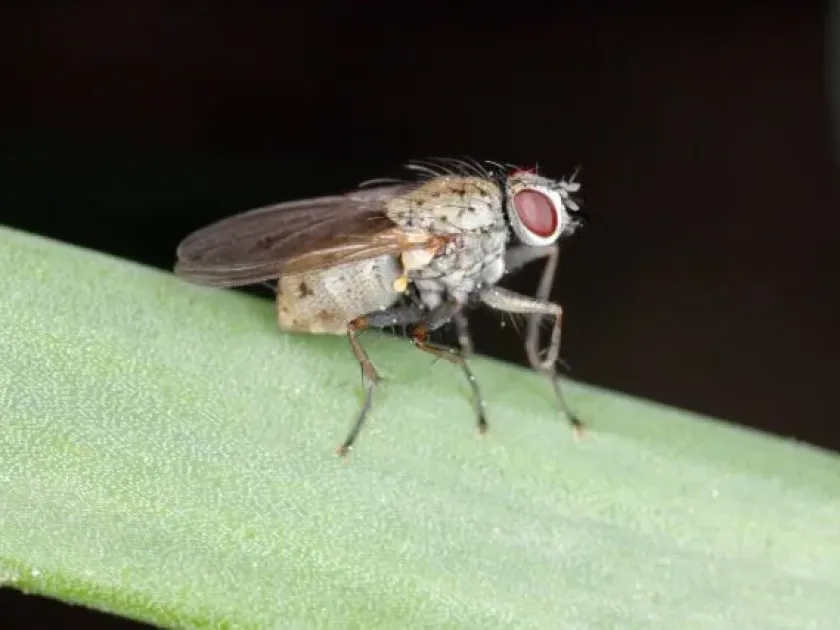
The onion fly (Delia antiqua) is a serious pest belonging to the order Diptera, family Anthomyiidae. Adult flies are small, ash-gray insects with a yellowish tinge, measuring about 6–7 mm in length.
The wings are clear with a slightly yellowish hue. Adult flies are typically seen hovering over crops during the spring, which aligns with the blooming periods of local vegetation.
The female lays white, elongated eggs singly or in groups near the base of the plant or under the loose soil surface. These eggs are quite small and often go unnoticed during field inspections.
The larva, which is the primary damaging stage, is legless, cylindrical, and white, reaching up to 10 mm when fully grown. It possesses sharp mouth hooks used for burrowing into the tissues of the plant.
The life cycle involves pupation in the soil at depths of up to 20 cm. The pupae overwinter in the soil, emerging as adults in the spring to begin the cycle again.
What it damages
The onion fly primarily attacks bulb onions, but it is known to be a polyphagous pest. In the absence of primary hosts, it can damage fodder beet, cabbage, and peas.
The larvae are opportunistic and can infest other vegetables including tomatoes, eggplants, and potatoes, especially when soil moisture is high and the plants are young.
While not a primary host, apple trees may occasionally serve as a substrate for egg-laying in moist soil surrounding the trunk, contributing to local pest population buildup.
The most severe damage occurs during the seedling stage. Infested plants show stunted growth as the larvae consume the roots and the base of the bulb, eventually leading to plant collapse.
Secondary infections, such as bacterial soft rot, often follow the initial damage caused by the maggots, rapidly destroying the bulb and making the crop unmarketable.
When it appears
The first generation of adults emerges in late spring, usually correlating with the flowering time of cherry trees and dandelions. This timing is critical for implementing preventive measures.
A second generation typically appears in mid-summer, posing a high threat to developing onion bulbs. This generation can significantly reduce the potential yield.
Under warm and moist conditions, a partial third generation may emerge in late summer, which is especially dangerous for late-maturing onion varieties.
The entire developmental cycle from egg to adult takes approximately 25 to 40 days, meaning that infestation can persist throughout the majority of the growing season.
Environmental factors, particularly soil temperature and humidity, play a major role in the speed of the pest's development and the intensity of its attack on crops.
Signs of infestation
The first external sign of infestation is the yellowing and wilting of the onion leaves. Affected leaves lose their turgor and turn brown from the tips downward.
When pulling on the yellowed leaves, they often come away from the soil easily because the root system has been largely destroyed by the feeding larvae.
Inspection of the bulb base reveals a characteristic foul smell of decay, indicating that the maggots have already invaded the internal tissues.
The presence of white maggots within the bulb or the basal plate is a definitive sign of an onion fly infestation. Often, multiple larvae can be found inside a single bulb.
Patches of dead or dying seedlings in an onion bed are a clear indicator of a severe infestation that requires immediate intervention to save the remaining crop.
Control measures
Crop rotation is the most effective cultural practice. Moving onion beds to areas where onions or related crops have not been grown for at least 3 years disrupts the life cycle.
Companion planting with carrots is a well-documented deterrent. The scent of carrot foliage masks the attractive odors of the onions, making it harder for the flies to locate their hosts.
Covering onion beds with fine-mesh insect netting during the peak flight period of the adults is a highly effective, non-chemical way to prevent egg-laying.
- Deep autumn plowing to bring pupae to the surface for cold exposure.
- Using early planting dates to allow plants to establish before the peak fly population.
- Application of wood ash or tobacco dust around the base of plants.
- Prompt removal and destruction of infested plants to prevent larval migration.
Chemical control involving systemic or contact insecticides should be applied during the periods of peak adult activity, ensuring that all safety labels and harvest intervals are followed.
In brief
11
Damages crops
Content graph
Damages crops · 11
Content graph
Connections · Onion fly
Most often together:
Marketplace
Products · 11


Biology
Taxonomy
- Latin name
- Delia antiqua
- Order
- Diptera (flies)
- Family
- Anthomyiidae
- EPPO code
- HYLEAN
Community
Discussion
No discussions yet — be the first.