

Pest · Diptera (flies) · affects Fodder beet, Winter wheat, Fruit crops
Especially harmful
Beet leaf miner
Pegomya hyoscyami
Description
How to identify
The beet leaf miner (Pegomya hyoscyami) belongs to the Anthomyiidae family. Adults are small, ash-grey flies, approximately 5–7 mm in length, characterized by distinct wing venation.
Larvae are white or yellowish, cylindrical, and headless, growing up to 8 mm. They are cryptic feeders, spending their entire larval development inside the mesophyll of host plant leaves.
The pupae are dark brown, barrel-shaped, and reside in the soil. This stage is crucial for the insect's survival during winter and adverse environmental conditions.
The female fly deposits eggs in small, orderly groups on the underside of leaves. The lifecycle from egg to adult is rapid, allowing for multiple generations per growing season.
Overwintering occurs as pupae at shallow depths (2–10 cm) in the soil, which is a key biological adaptation for surviving seasonal climate shifts.
What it damages
This pest primarily attacks members of the Amaranthaceae family, most notably sugar beet, mangel, and spinach. It causes significant damage by rendering leaves necrotic.
While some reports mention other crops like wheat or barley, these occurrences are usually incidental and not considered primary host plants for this species.
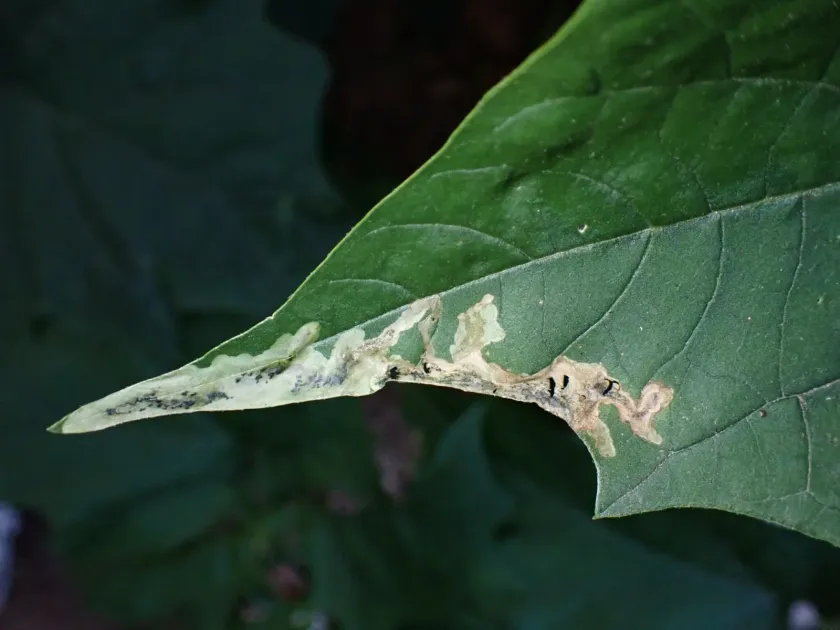
Larvae consume the inner tissue between the upper and lower leaf surfaces, creating characteristic serpentine or blotch-shaped mines that reduce photosynthetic efficiency.
Severe infestations cause leaves to wither, curl, and turn yellow, which significantly stunts the growth of the plant and reduces overall yield and sugar content in beets.
Economic damage is most severe when seedlings are attacked early, potentially leading to total loss of individual plants in the field.
When it appears
The first generation of adults emerges in early spring, coinciding with the germination and early development of beet crops, typically in May.
Subsequent generations overlap throughout the summer months, with activity peaks often linked to warm, humid weather conditions.
The duration of the lifecycle is highly dependent on ambient temperature, meaning that warmer regions may experience up to four generations per season.
As autumn approaches and day length decreases, the final generation of larvae pupates in the soil to initiate the overwintering phase.
Predicting emergence timing is vital for farmers to implement control measures before the eggs are laid and larvae begin mining.
Signs of infestation
The most distinctive symptom is the appearance of translucent, blister-like blotch mines on the foliage that look white or pale green against the leaf surface.
Accumulated frass (larval excrement) is often visible inside the mines as small, dark deposits, confirming that the damage is caused by insect feeding.
In cases of heavy infestation, multiple mines may merge, causing the entire leaf to die prematurely, which leads to a scorched or burnt appearance of the crop field.
Plants affected by the miner show signs of nutrient stress and reduced vigor, often failing to reach their full potential size or sugar accumulation levels.
Regular scouting of field margins and the underside of leaves is necessary to detect eggs before the larvae bore into the plant tissue.
Control measures
Deep plowing in autumn is the primary cultural control method, as it buries the pupae deep in the soil, preventing successful emergence in the spring.
Effective weed management, especially targeting host weeds like lambsquarters (Chenopodium album), reduces the source of infestation for neighboring beet fields.
Chemical control should prioritize systemic insecticides that can penetrate leaf tissue to reach the protected larvae inside the mines.
Rotating crops away from Amaranthaceae hosts for at least two years helps break the lifecycle and reduce the local population of the pest.
- Monitoring with yellow sticky traps to track adult fly population levels.
- Applying insecticides at the peak of egg-laying or early larval stage.
- Encouraging natural predators and parasitoids that target the larval stage.
- Implementing integrated pest management (IPM) to maintain ecological balance.
In brief
4
Damages crops
Content graph
Damages crops · 4
Reference
Connections · Beet leaf miner
Most often together:
Marketplace
Products · 3

Biology
Taxonomy
- Latin name
- Pegomya hyoscyami
- Order
- Diptera (flies)
- Family
- Anthomyiidae
- EPPO code
- PEGOHY
Community
Discussion
No discussions yet — be the first.