
Senecio fly
Botanophila seneciella
Description
How to identify
The Senecio fly (Botanophila seneciella) is a member of the Anthomyiidae family, commonly known as the flower fly. These insects are small, typically dark-colored flies that have evolved to live in close association with specific host plants.
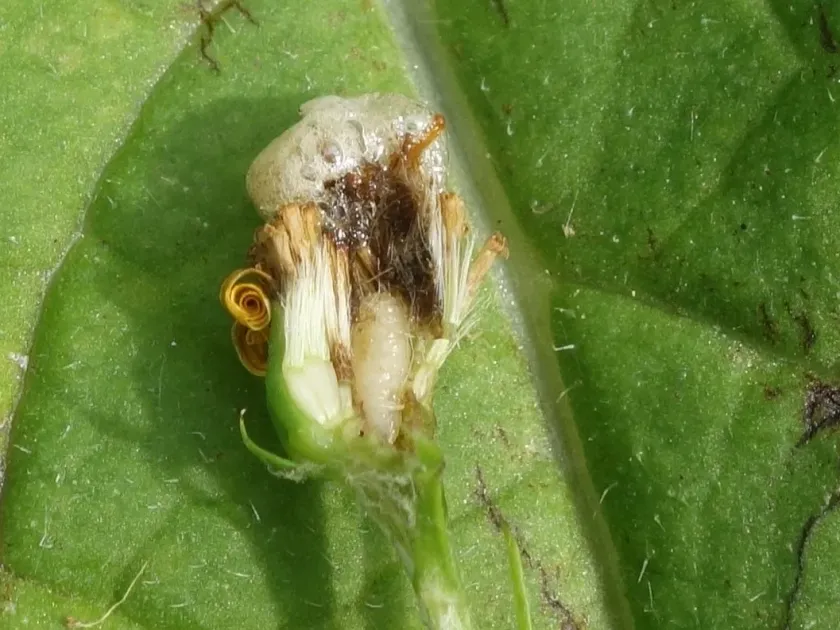
The larvae are small, white, and legless, perfectly adapted to live and feed within the flower heads of their host plants, particularly the Senecio species.
Adult flies are highly active during the plant's flowering season, which is crucial for their mating and egg-laying success. They possess specialized mouthparts for feeding on floral resources.
Taxonomically, they are categorized within the order Diptera, family Anthomyiidae. They are often overlooked by casual observers due to their small size and nondescript appearance.
Correct identification often relies on the specific damage pattern observed on Senecio plants, rather than the appearance of the adult fly itself.
What it damages
The primary damage is caused by the larvae, which burrow into the flower heads of Senecio plants to feed on the developing seeds and floral tissues.
This feeding behavior effectively sterilizes the flower, preventing the plant from producing viable seeds, which is a major concern for the plant's reproduction.
While often seen as a beneficial biocontrol agent against invasive ragwort (Senecio species), they can be problematic in nurseries cultivating ornamental Senecio varieties.
The damage often results in deformed, discolored, or prematurely withered flower heads that fail to open properly.
Furthermore, the presence of larval waste and the destruction of internal structures can make the plant susceptible to secondary fungal or bacterial pathogens.
When it appears
The lifecycle of the Senecio fly is tightly synchronized with the flowering phenology of its host plants, typically occurring in late spring and early summer.
Adult females deposit their eggs directly into the buds, ensuring the larvae have immediate access to nutrients upon hatching.
Developmental speed is highly temperature-dependent, leading to variation in the number of annual generations depending on the regional climate.
Pupation occurs in the soil or within the spent flower heads, providing a stage for overwintering until the next season begins.
Emergence of the adult flies usually coincides with the first flush of flowers, ensuring the survival of the subsequent generation.
Signs of infestation
Early signs of infestation include the wilting of flower buds that should otherwise be healthy and robust.
A tell-tale sign is the presence of frass or waste products visible around the base of the flower head or within the bracts.
Lack of seed set in a flower that appears otherwise normal is a common indicator that larvae have consumed the internal reproductive parts.
Deformed flower heads that look stunted or asymmetrical are frequently inhabited by larvae feeding inside.
Increased activity of small, grayish flies hovering around Senecio patches during the bloom period suggests active egg-laying behavior.
Control measures
The most effective physical control method is the manual removal and disposal of infested flower heads before the larvae can pupate.
Cultivation practices such as deep soil turning at the end of the season can destroy pupae overwintering in the ground.
In ornamental settings, biological controls or specific, targeted pesticides may be used, although they are generally avoided if the plant is considered a weed.
Maintaining plant health and ensuring proper site maintenance helps reduce the attractiveness of the area to egg-laying females.
- Regular monitoring of flower buds for early infestation.
- Manual removal of damaged heads to stop the life cycle.
- Strategic weed control of wild Senecio reservoirs.
Taxonomy
- Latin name
- Botanophila seneciella
- Order
- Diptera (flies)
- Family
- Anthomyiidae
- EPPO code
- HYLESE
Discussion
No discussions yet — be the first.