

Pest · Lepidoptera (butterflies)
Raspberry bud moth
Lampronia morosa
Description
How to identify
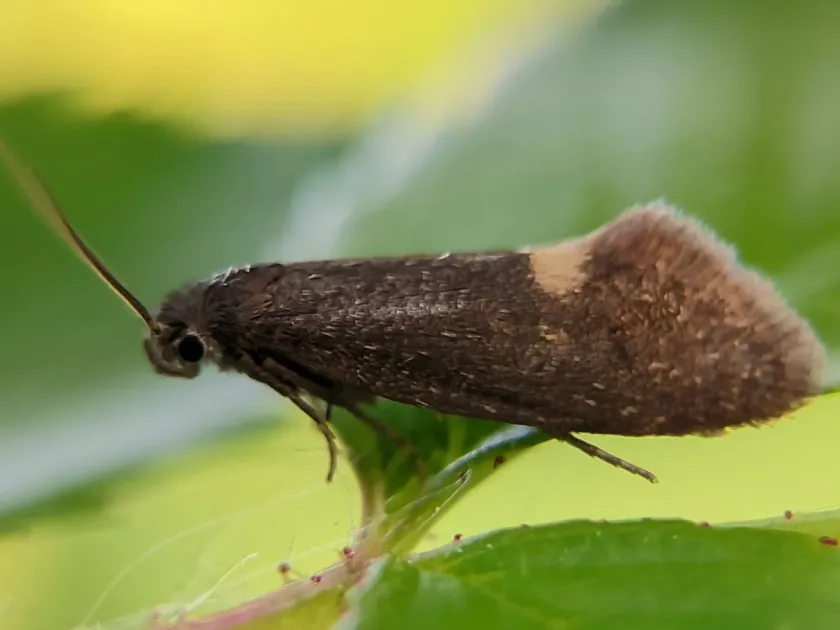
The raspberry bud moth (Latin: Lampronia morosa, often referred to as Lampronia rubiella) is a small moth belonging to the Prodoxidae family, known as a significant pest of Rubus species.
Adult moths have a wingspan of approximately 12–14 mm and feature dark brown wings marked with distinct yellowish-white spots, making them relatively inconspicuous on foliage.
The larvae are small, reaching up to 8 mm in length, and are typically bright crimson or reddish, which provides a useful diagnostic feature for early identification in the spring.
The species has a univoltine life cycle, meaning there is only one generation per year. Winter is spent as young larvae in tightly woven cocoons hidden within bark crevices near the base of canes.
The timing of larval emergence is strictly synchronized with the phenological development of the host plant, specifically the bud burst stage, which is the most critical period for intervention.
What it damages
The primary host for this pest is the raspberry plant, though it can occasionally infest blackberries, leading to significant reductions in fruit yield and plant vigor.
Damage is exclusively caused by the larvae. In early spring, they bore into the developing buds, consuming the internal tissues, which effectively prevents the buds from opening and producing flowers.
If the buds are destroyed, the larvae may tunnel into the developing shoots, causing the tops of the canes to wilt and die back suddenly, which can be mistaken for other stem-boring insects.
The economic impact is most severe during springs with cool, prolonged temperatures, which extend the period during which buds remain vulnerable to larval feeding.
Repeated or high-density infestations can lead to substantial crop loss, as a single larva may destroy multiple buds on a single cane before reaching maturity.
Signs of infestation
The most visible sign of infestation is the failure of buds to sprout in the spring, with affected buds appearing withered, dry, or showing tiny entry holes at their base.
Frass (larval excrement) is often visible around the entry holes in the buds, providing clear evidence that the larvae have been actively feeding inside the tissue.
Wilting of the shoot tips during the rapid growth phase is a secondary indicator, signaling that the larvae have moved from the buds to the soft interior tissues of the young canes.
During the flowering stage, infested buds may drop prematurely, or the resulting berries may be malformed if the larvae have damaged the reproductive parts of the flower.
- Failure of buds to develop.
- Visible entry holes with frass in bud clusters.
- Wilting and necrosis of shoot tips.
- Premature fruit or bud drop.
Control measures
Cultural control is highly effective: regular pruning and destruction of old, infested canes help remove the primary hibernation sites and significantly reduce the pest population.
Cultivating the soil in autumn around the base of the bushes helps disrupt the cocoons and exposes larvae to harsh winter conditions and predators, reducing the overwintering success rate.
Chemical applications should be timed precisely with the "green cone" stage when larvae are emerging from their cocoons and are most vulnerable before they fully bore into the buds.
Monitoring using pheromone traps is a recommended professional practice to determine the exact flight peak of the moths, allowing for optimized insecticide or biological spray timing.
Integrated pest management (IPM) practices, including the use of biological control agents during the flowering period, help keep the population below the economic threshold without harming pollinators.
Content graph
Connections · Raspberry bud moth
Most often together:
Marketplace
Products · 1
Biology
Taxonomy
- Latin name
- Lampronia morosa
- Order
- Lepidoptera (butterflies)
- Family
- Prodoxidae
- EPPO code
- INCUMO
Community
Discussion
No discussions yet — be the first.