

Rusty grain beetle
Laemotmetus ferrugineus
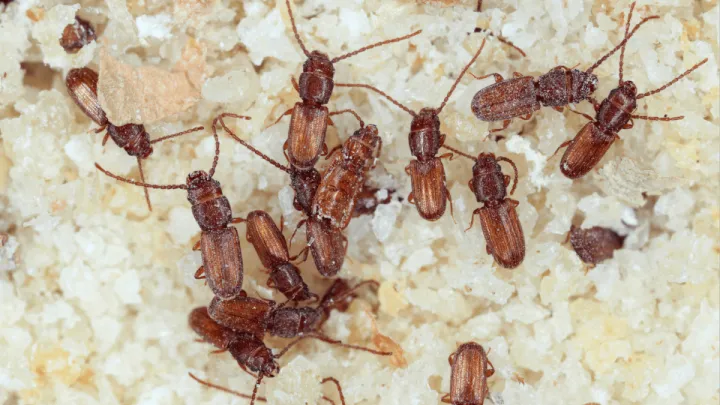
Description
How to identify
The rusty grain beetle (Laemotmetus ferrugineus) belongs to the order Coleoptera and the family Laemophloeidae. It is a tiny insect, usually measuring 2–3 mm in length, characterized by a noticeably flattened body.
The beetle has a reddish-brown color and a shiny appearance, with fine hair covering its body that can be seen under magnification. This morphology allows it to thrive in tight spaces within grain heaps.
Its head is broad with distinct temples, and the antennae are filiform, often reaching up to half the body length, which serves as a key diagnostic feature for identification.
Larvae are mobile, measuring 3–4 mm, and are pale white. They are distinguished by two distinct hook-shaped appendages (cerci) at the rear end of their body, which is a key identifying trait.
The life cycle is completed in approximately one month under optimal conditions (25–30 °C), allowing the population to increase rapidly within a short period of time inside storage facilities.
What it damages
The rusty grain beetle is a major stored product pest, primarily attacking grain that already has high moisture content or has been partially damaged by other insects or molds.
Common hosts include wheat, rye, corn, barley, as well as processed food products such as flour, cereal grains, bran, and various dried vegetable and animal feed components.
It is generally unable to attack healthy, dry, and intact grain. Its presence is considered a direct indicator of improper storage conditions, specifically high moisture levels.
When infestation becomes severe, beetles aggregate in the top layers of grain bulk, causing grain overheating, which leads to significant spoilage and the spread of microorganisms.
Both adults and larvae feed on the grain embryo and endosperm, causing a reduction in germination capacity and making the grain unfit for food processing or industrial use.
Signs of infestation
The first sign of infestation is often a characteristic musty or moldy odor in the storage facility, resulting from the insect's activity and associated microbial growth.
Visual inspection of the grain surface often reveals small, active beetles that move quickly away from disturbances, hiding deep into the substrate to avoid light and movement.
The presence of insect excrement, cast skins, and silken webs within the flour or grain mass confirms an active infestation cycle and the accumulation of a new generation.
In cases of advanced infestation, the product may form hard, web-bound clumps, which are easily detected when sieving the grain or inspecting the storage bags.
Maintaining moisture levels below 14% is crucial, as any increase in moisture creates an environment where the rusty grain beetle can proliferate and expand its colony.
Control measures
The primary control strategy involves strict adherence to temperature and moisture standards to prevent grain heating and create an environment unsuitable for the beetle's life cycle.
Regular warehouse sanitation is essential; this includes removing all dust, debris, and leftover grain that could harbor populations of the pest between harvest seasons.
Preventive disinfection of storage facilities using professional fumigation or aerosol treatments prior to loading new batches is a standard practice for protecting grain quality.
In the event of an active infestation, grain fumigation using phosphine-based products is the standard approach, provided it is conducted by certified professionals under strict safety rules.
The use of airtight storage systems and active aeration units helps maintain consistent conditions, effectively preventing the conditions required for the rusty grain beetle to settle.
Content graph
Connections · Rusty grain beetle
Most often together:
Marketplace
Products · 24


Fostoxin (Detya Gas-Ex-T)
Детіа Дегеш ГмбХ, Німеччина.
Herbicides
0
0
·
58
1 offer
1.55 €per pack
Buy

Phosphir, TB (aluminum phosphide, 560 g/kg)
Nanjing Red Sun
Herbicides
0
0
·
50
2 offers
19.18 €per pack
Buy


Biology
Taxonomy
- Latin name
- Laemotmetus ferrugineus
- Order
- Coleoptera (beetles)
- Family
- Cucujidae
- EPPO code
- LAEMFE
Community
Discussion
No discussions yet — be the first.