
Flat grain beetle
Cryptolestes
Description
How to identify
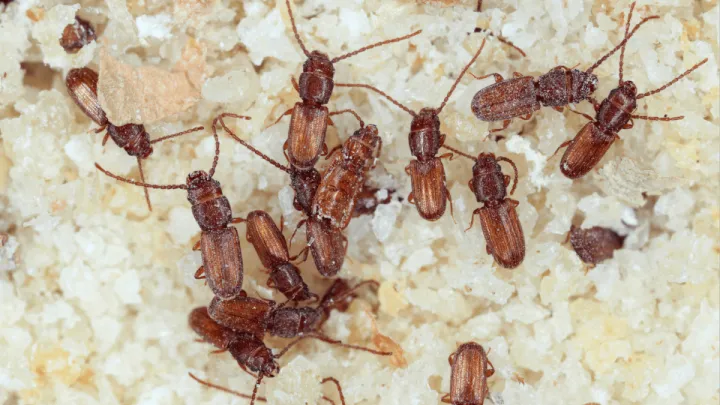
The Flat grain beetle (genus Cryptolestes) belongs to the Laemophloeidae family and is a significant global pest of stored commodities. These beetles are tiny, measuring between 1.5 and 2.5 mm in length, with a notably flat, reddish-brown body that allows them to inhabit the smallest crevices within grain storage facilities.
The antennae are long and filiform, often reaching the length of the body, which is a key identifying feature. The pronotum has distinctive lateral edges, and their flattened appearance distinguishes them from other common storage pests like the confused flour beetle.
Larvae are small, roughly 3–4 mm, elongated, and pale, with two dark, hook-like structures at the posterior end. They are typically found deep within the grain mass, making them difficult to detect during early stages of infestation.
These insects are highly sensitive to humidity and temperature. They thrive in environments where the moisture content of grain is relatively high, often colonizing grain that is already slightly damaged or dusty.
Due to their small size and cryptic behavior, populations can expand rapidly. An infestation often goes unnoticed until the sheer number of beetles causes noticeable changes in grain temperature or quality.
What it damages
Flat grain beetles primarily infest cereals, including wheat, barley, rye, corn, and rice, as well as milled products like flour and breakfast cereals. They are categorized as secondary pests but can become primary destroyers when conditions are favorable.
The larvae specifically target the germ (embryo) of the grain kernel. This feeding behavior is particularly destructive for seed stock, as it directly kills the seed's viability, making it useless for planting purposes.
When present in large numbers, the beetles create hot spots within the stored grain mass. This increase in temperature and local humidity facilitates the growth of mold and mycotoxin-producing fungi, further degrading the grain quality.
Infested products often contain cast larval skins, frass (excrement), and silk webbing. This contamination leads to an unpleasant musty odor and renders the grain unsuitable for food consumption or processing.
Because they frequently hide in cracks in walls, under floorboards, and within conveyor machinery, they are notoriously difficult to eliminate completely from grain elevators and processing facilities.
When it appears
As stored-product pests, Flat grain beetles are not restricted by seasonal cycles of field crops. They can reproduce year-round within climate-controlled storage facilities or grain silos where temperatures remain above 15°C.
Activity levels fluctuate throughout the year depending on warehouse temperature management. During the warmer months, their metabolic rate increases, leading to more rapid life-cycle turnover and larger population explosions.
In colder regions, they may remain dormant in unheated areas; however, internal heat generated by grain respiration or previous pest activity can create micro-climates that allow them to survive harsh winters.
Risk is highest during the harvest season when new, warm grain is introduced into storage. If the facility already harbors a residual population of beetles, cross-contamination is nearly instantaneous.
Regular monitoring using traps is essential during every season. Vigilance is particularly important after periods of high humidity, as moisture significantly boosts their reproductive success.
Signs of infestation
A classic sign of an infestation is a distinct, musty smell emanating from the grain bin. This odor is often the first warning sign that the grain has begun to deteriorate due to insect activity and subsequent fungal growth.
- Detection of live adult beetles on the surface of the grain or in inspection probes.
- A noticeable increase in grain temperature (hot spots) detected by monitoring cables.
- Accumulation of fine grain dust or "flour" on the floor or near equipment.
- Visible damage to kernels, particularly empty, hollowed-out embryos.
- Presence of webbing or clumps of grain, indicating secondary mold development.
Professional grain managers often use sieving techniques to detect early-stage populations. A representative sample is taken from various depths, sifted, and examined under magnification to confirm the presence of eggs, larvae, or adults.
Control measures
The most effective management strategy is the "Clean-Store-Monitor" protocol. Before the grain arrives, the storage site must be thoroughly cleaned, removing all remnants of old grain where beetles hide.
Physical control involves drying the grain to a moisture content below 13%. Flat grain beetles struggle to survive and reproduce in dry environments, making moisture control one of the most effective non-chemical deterrents.
Fumigation is the standard chemical intervention. Phosphine gas is commonly used in hermetically sealed silos to reach insects deep within the grain mass, effectively eliminating all life stages, including hidden larvae.
Mechanical aeration is also vital. By keeping the grain cool, managers can suppress the beetle's biological development cycle, thereby preventing the rapid population spikes that lead to significant crop loss.
Finally, exclusion practices are key. This includes sealing gaps in facility structures, screening aeration vents to prevent entry, and ensuring that any incoming grain or used machinery is inspected for signs of the pest before entering the storage system.
Taxonomy
- Latin name
- Cryptolestes
- Order
- Coleoptera (beetles)
- Family
- Cucujidae
- EPPO code
- CRYLSP
Discussion
No discussions yet — be the first.