
Flat grain beetle
Cucujus
Description
How to identify
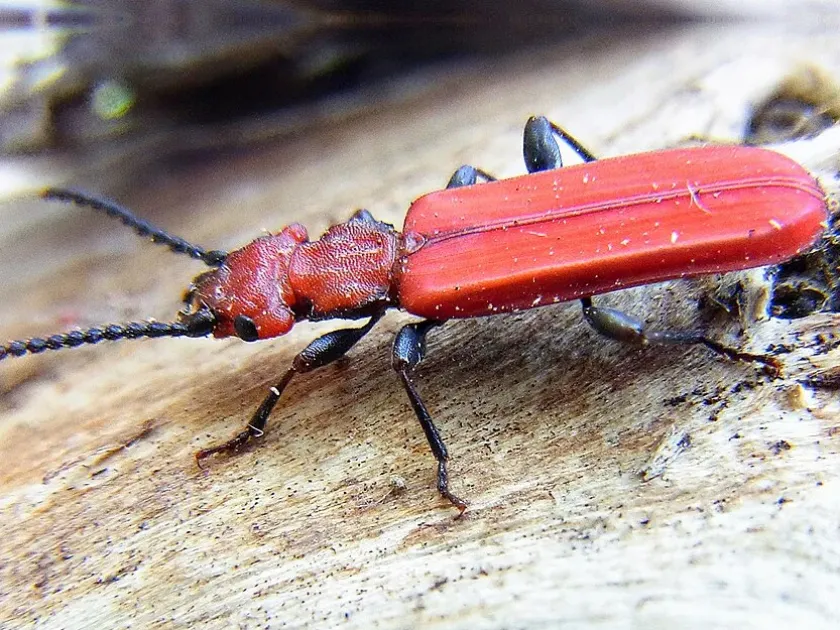
The flat grain beetle, belonging to the genus Cucujus and the family Cucujidae, is easily recognizable by its extremely flattened, elongated body shape. This morphological adaptation allows it to inhabit narrow spaces and crevices, including those beneath tree bark and inside grain handling equipment.
Adult beetles typically measure between 6 and 15 mm in length. Their coloration ranges from a vibrant reddish-brown to dark brown. The head is relatively large and equipped with strong mandibles, while the elytra often feature distinct ridges that enhance their rugged appearance.
The larvae are also elongated and protected by a somewhat hardened exoskeleton. A key identifying feature is the presence of two prominent, curved, spine-like structures called cerci on the posterior end of the abdomen.
Taxonomically, they are classified under the order Coleoptera. Many species in this genus are cold-hardy, possessing physiological mechanisms to survive freezing temperatures, which makes them resilient pests in unheated storage facilities.
While some species are primarily wood-borers in forest ecosystems, the genus includes significant pests of stored products that have successfully adapted to human-made structures like silos and warehouses.
What it damages
The flat grain beetle is a significant pest in agricultural storage, primarily targeting cereal grains such as wheat, barley, rye, and oats. They are often considered secondary pests, but can cause substantial economic losses in poorly maintained storage systems.
The primary damage is caused by both larvae and adults feeding on the germ of the grain kernel. By consuming the germ, they severely reduce the seed's viability, making it useless for planting and lowering its overall nutritional value.
Beyond feeding, the beetles contaminate grain batches with their frass, cast larval skins, and secretions. This contamination reduces the grade of the grain, affecting its marketability and potential for food processing.
The presence of these pests often triggers the process of grain "hot spots" or self-heating. This heat generation creates an environment conducive to the growth of fungi, molds, and the proliferation of other storage-related insect pests.
Besides whole grains, these insects are known to infest flour, semolina, dried fruits, and other vegetable-derived products that are stored in warehouses for extended periods.
When it appears
The activity and development cycle of the flat grain beetle are heavily influenced by environmental temperature. Development is most rapid at temperatures between +20°C and +28°C, leading to multiple overlapping generations per year in warm climates.
In temperate zones, during colder months, the beetle often enters a state of dormancy, though it remains capable of surviving harsh winters by seeking refuge in protected corners of storage infrastructure.
Springtime warming acts as a trigger for adults to resume mating and oviposition. Monitoring should be particularly rigorous during this period to catch potential infestations before they reach critical levels.
The life cycle encompasses four main stages: egg, larva, pupa, and adult. The total duration of the cycle varies greatly, largely depending on the moisture content of the stored grain and ambient temperature.
Adult beetles are relatively long-lived and exhibit high search capabilities, allowing them to locate suitable food sources within large storage facilities even under less than optimal conditions.
Signs of infestation
One of the earliest signs of infestation is the presence of grain kernels with hollowed-out embryos. These kernels appear damaged and often have irregular exit holes left by developing larvae.
A musty or moldy odor emanating from a grain mass is a strong indicator of an active infestation, as the beetles' activity often facilitates microbial growth and moisture accumulation.
Visual detection of small, reddish-brown beetles crawling on the surface of grain or within crevices of wooden pallets and storage bins confirms the presence of an infestation.
Finding a buildup of fine dust (frass) and insect debris at the bottom of bins or near loading equipment is a clear indication that the insect population has become well-established.
Monitoring with probes and temperature sensors can detect localized "hot spots" within the grain mass, which is a classic sign of internal heating caused by high beetle activity.
Control measures
Effective management begins with stringent sanitation practices. Warehouses must be thoroughly cleaned of all residual grain, dust, and debris that could serve as a breeding site during the off-season.
Before introducing new grain, empty silos and storage units should be treated with appropriate contact insecticides to ensure a pest-free starting environment.
Maintaining low moisture levels (below 14%) and low temperatures (through aeration or refrigeration) are the most effective non-chemical strategies for suppressing beetle populations.
- Regular inspection and sampling of stored grain.
- Using hermetic storage systems where possible.
- Application of structural sprays to surfaces.
- Fumigation of infested grain batches by certified professionals.
If an infestation is detected, immediate action is required, including the mechanical cleaning of grain to remove infested particles or the use of approved fumigants to eliminate the insects effectively.
Taxonomy
- Latin name
- Cucujus
- Order
- Coleoptera (beetles)
- Family
- Cucujidae
- EPPO code
- CUUJSP
Discussion
No discussions yet — be the first.