
Cryptamorpha desjardinsi
Cryptamorpha desjardinsi
Description
How to identify
Cryptamorpha desjardinsi belongs to the Silvanidae family (flat bark beetles). This insect has a flattened, elongated body, which allows it to thrive in narrow crevices, under bark, or within packed plant material.
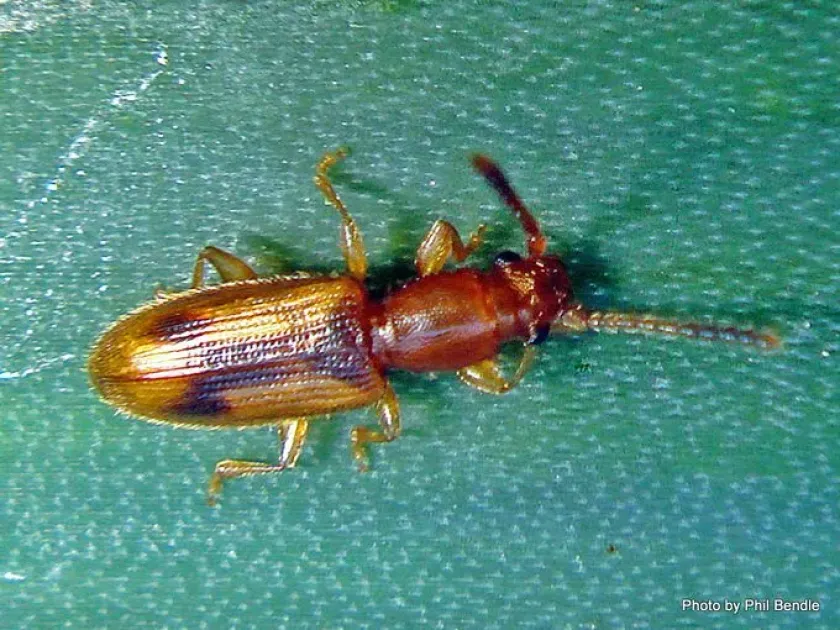
Adult beetles typically measure 3–4 mm in length. Their coloration ranges from light brown to reddish-tan, often featuring darker markings on the elytra, which provides excellent camouflage against natural surfaces.
The larvae are also elongated and possess well-developed mouthparts suited for feeding on plant tissues. They are highly mobile, actively searching for suitable food sources across the host plant's surface.
As a member of the Coleoptera order, the species exhibits a complete life cycle. Its long antennae are essential for sensory perception, helping the beetle navigate complex environments and locate mating partners.
Though native to tropical regions, this species is frequently encountered globally as a stowaway in international shipments of fruit, particularly bananas, and other imported horticultural products.
What it damages
This pest is known to affect a variety of plants, including bananas, citrus trees, and numerous ornamental species kept in greenhouses or nurseries. It is particularly problematic in storage and transport conditions.
Adult beetles and their larvae feed on leaf epidermis and the skin of fruits. These feeding patterns create unsightly blemishes, which significantly decrease the market value of the produce and allow secondary pathogens to enter.
In greenhouse settings, Cryptamorpha desjardinsi may cause damage to young shoots and budding points, which can lead to stunted growth or deformation of the plant's vegetative structure.
Widespread infestations can quickly impact entire plant collections, leading to the rapid decay of leaves and stems. This is especially concerning for rare or sensitive ornamental species.
The economic impact of this pest stems from both direct damage to crops and the costs associated with implementing intensive pest control measures to mitigate losses in commercial horticulture.
When it appears
In outdoor environments, the activity of the beetle is strongly dictated by ambient temperature. It thrives best in warm, humid climates where temperatures consistently remain above 20°C.
Within greenhouses and warehouses, the pest can remain active throughout the year. The controlled environment provides a stable climate that facilitates continuous breeding cycles and rapid population growth.
The lifecycle consists of four distinct stages: egg, larva, pupa, and adult. Females typically lay eggs in protected spots, such as leaf axils or under bark flakes, to ensure the survival of the offspring.
The presence of decaying plant material acts as a significant catalyst for population expansion, providing both a supplementary food source and a secure environment for larvae development.
In non-native regions, seasonal outbreaks are often triggered by the introduction of infested plant material, which then adapts to the local microclimate of botanical gardens or indoor facilities.
Signs of infestation
The earliest signs of an infestation include small, irregular feeding marks or holes on the leaf blades. Damage is often concentrated near the junction of the petiole and the stem.
On fruits, one might observe surface grazing or small pit-like lesions. These areas frequently serve as entry points for fungi, leading to rot that can spread quickly through a storage crate.
Adult beetles can be detected during inspections; they are skittish and tend to move rapidly toward dark crevices, the undersides of leaves, or plant joints when disturbed.
Larval activity is characterized by the presence of fine frass and feeding tunnels on the surface of plant parts. Small larvae may also be found hiding under dry plant scales.
- Yellowing and premature wilting of foliage.
- Deformation of young shoots and buds.
- Visible fungal growth spreading from feeding sites.
- Presence of small brown beetles on plant surfaces.
Control measures
The primary method of control is rigorous phytosanitary inspection of all incoming plant shipments. Early detection at border points is the most effective way to prevent the establishment of the pest.
Mechanical management, such as pruning and destroying heavily infested leaves or shoots, helps to curb the spread of the insect population within a controlled growing environment.
The application of systemic or contact insecticides may be necessary in commercial operations. It is crucial to choose products approved for greenhouse use and strictly follow the pre-harvest intervals.
Maintaining high standards of sanitation, including the regular removal of plant debris and cleaning of storage areas, significantly reduces the availability of breeding grounds for the pest.
Biological control programs, which utilize specific predators or parasites, are increasingly being adopted to reduce reliance on chemicals while effectively managing pest populations in greenhouses.
Taxonomy
- Latin name
- Cryptamorpha desjardinsi
- Order
- Coleoptera (beetles)
- Family
- Cucujidae
- EPPO code
- CRPMDE
Discussion
No discussions yet — be the first.