

Pest · Coleoptera (beetles) · affects Field pea, Apple, Strawberry
Especially harmful
Lethrus apterus
Lethrus apterus
Description
How to identify
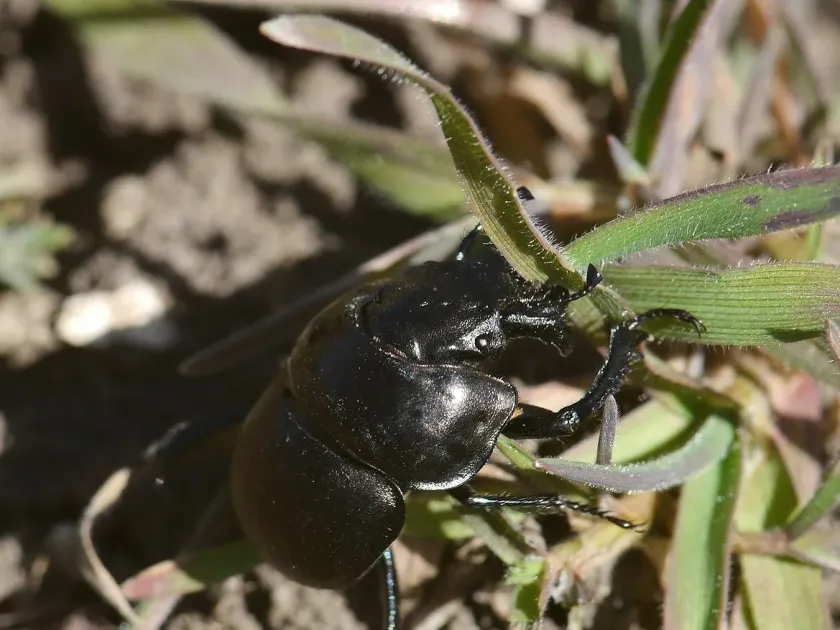
Lethrus apterus, commonly known as the judge beetle, is a species of flightless beetle belonging to the family Geotrupidae, order Coleoptera.
Adult beetles have a shiny black body and measure approximately 15–20 mm in length. Males are easily recognized by the large, prominent horn-like structures on their mandibles.
The larvae are typically C-shaped, off-white or yellowish, and live in underground burrows, where they are fed by the parents.
Since the wing covers are fused, these beetles are entirely terrestrial and cannot fly, which limits their spread but makes them persistent residents of specific areas.
The life cycle is strictly soil-dependent, with both the larval stage and overwintering adults residing within deep, vertical burrows.
What it damages
This beetle is a significant pest of cereal crops, including wheat, barley, and rye, as well as sunflowers, sugar beets, and various legumes.
Damage is primarily caused by adult beetles in the spring, as they cut off tender young shoots of crops to provide food for their offspring in underground nests.
When populations are high, they can cause extensive destruction on the margins of fields, leading to significant thinning of crop density.
The plants are usually cut clean at the base, and the foliage is dragged into the burrow, effectively removing the plant's ability to regenerate or perform photosynthesis.
Cumulative damage during the early growth stages of crops leads to major yield losses, especially in fields adjacent to uncultivated lands or tree belts.
When it appears
The beetles emerge from their overwintering burrows in the spring, typically when soil temperatures reach 8 to 10 degrees Celsius.
The peak period of activity occurs in April and May, coinciding with the tillering phase of winter cereals, which is the most critical time for crop protection.
Throughout the summer, the larvae develop inside the burrows, consuming the plant matter cached by the adults until they reach maturity.
New generation adults emerge in late summer or autumn but remain underground in their nests to overwinter, completing a one-year life cycle.
As they do not migrate by flight, the timing of their emergence is predictable, allowing for targeted chemical or mechanical interventions.
Signs of infestation
The most evident sign of infestation is the presence of neatly cut shoots along the edges of the field, resembling the work of a small harvester.
Small circular holes about 1 cm in diameter, often surrounded by excavated soil mounds, indicate the location of the beetles' burrows.
If you observe missing foliage or stems being dragged into the soil, it is a clear indicator that Lethrus apterus is active in the area.
Large bare patches (gaps) starting from the field borders and moving inwards are characteristic signs of established beetle colonies.
Spotting the adult beetles themselves, particularly the horned males during their morning activity, confirms the pest's presence.
Control measures
Effective control relies on integrated pest management (IPM) practices, emphasizing soil tillage and targeted chemical applications.
Deep autumn plowing with soil inversion is the most effective mechanical method for destroying the underground nests and killing larvae and pupae.
Maintaining clean field borders and eliminating weeds on adjacent land prevents the beetles from building up large populations before migrating to crops.
During the spring emergence, applying insecticides to the border zones of the fields is highly effective at preventing the spread of the pest into the crop.
- Deep tillage for nest destruction.
- Border spray applications with contact insecticides.
- Monitoring fields during the early tillering stage.
- Clearing surrounding areas of dense vegetation.
Content graph
Connections · Lethrus apterus
Most often together:
Marketplace
Products · 1
Biology
Taxonomy
- Latin name
- Lethrus apterus
- Order
- Coleoptera (beetles)
- Family
- Geotrupidae
- EPPO code
- LETRAP
Community
Discussion
No discussions yet — be the first.