
Forest dung beetle
Geotrupes stercorosus
Description
How to identify
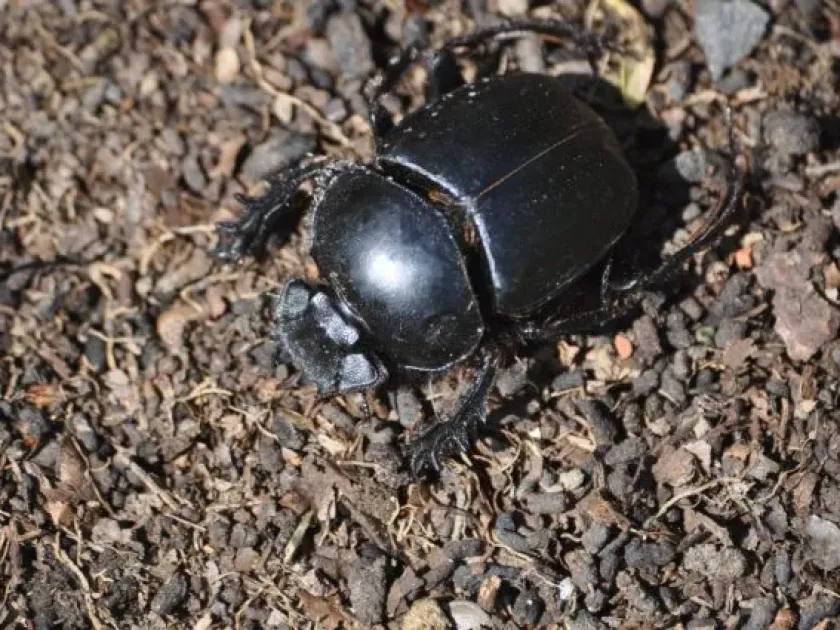
The forest dung beetle is a member of the Coleoptera order and the Scarabaeidae family. The adult beetle is a robust insect measuring 15–25 mm, usually black with a metallic blue or purple sheen.
Its elytra feature distinct longitudinal grooves, while the pronotum is smooth and convex. The head is equipped with short antennae that end in a characteristic three-plated club.
The larva is fleshy, white, and C-shaped, with a brown head and strong mandibles suited for processing organic matter within the soil profile.
Adult beetles are primarily nocturnal, showing peak activity during twilight or cloudy days when moisture levels are sufficient for their digging activities.
Field identification requires examining the tibial structures and elytra patterns, often aided by a magnifying glass to confirm the species Geotrupes stercorosus.
What it damages
The damage caused by the forest dung beetle is primarily mechanical, occurring when adults dig deep tunnels that disrupt the root systems of crops.
Young trees, berry bushes, and certain vegetable crops often suffer from wilting when their root zones are undermined by the beetles' nesting behavior.
Larvae living in the soil may accidentally sever roots while foraging for food, which can be devastating for seedlings in nursery environments.
In intensive agricultural settings, the tunneling activity can lead to air pockets around roots, causing desiccation and secondary stress to the affected plants.
Furthermore, these beetles can act as indirect vectors for soil-borne pathogens, as they transport fungal spores on their bodies while moving through the soil.
When it appears
Adult flight typically begins in spring as soil temperatures rise and continues throughout the summer and early autumn months.
Activity levels are highest during warm and humid weather, as moisture makes the soil easier to penetrate for the creation of subterranean galleries.
The life cycle of this beetle is relatively long, with larval development lasting one to two years depending on the local environmental conditions.
Both adults and larvae overwinter deep within the soil, typically below the frost line, to survive colder winter temperatures effectively.
The emergence of adults often coincides with the active growth phase of many garden plants, necessitating proactive monitoring during the early season.
Signs of infestation
The most visible sign of infestation is the appearance of holes in the soil surface surrounded by small mounds of earth, resembling those of rodents.
Plants wilting without any obvious above-ground pest damage are a frequent indicator that their root system has been compromised by tunnel digging.
Inspecting the root ball of dying plants often reveals hollowed-out tunnels and may lead to the discovery of C-shaped larvae within the soil.
A high density of beetles near manure piles or composting areas is a clear indicator of a population outbreak that poses a risk to nearby crops.
When fresh soil disturbances are found in fields, an entomological inspection should be conducted to determine the presence of larvae and adult nesting.
Control measures
Deep autumn tillage is the most effective agronomic method for disrupting the beetle's life cycle, as it destroys tunnels and exposes larvae to predators.
Management strategies should focus on removing manure or organic waste from the immediate vicinity of sensitive crops to reduce attractants for the beetles.
Soil-applied insecticides may be used in commercial nurseries where the pest pressure is severe and other non-chemical methods are insufficient.
Trapping adults using organic matter as bait can help suppress local populations if the traps are checked and cleared on a consistent schedule.
- Crop rotation to break the developmental cycle
- Application of entomopathogenic fungi
- Manual removal of larvae during soil cultivation
Taxonomy
- Latin name
- Geotrupes stercorosus
- Order
- Coleoptera (beetles)
- Family
- Geotrupidae
- EPPO code
- GEOUST
Discussion
No discussions yet — be the first.