
Minotaur beetle
Typhaeus
Description
How to identify
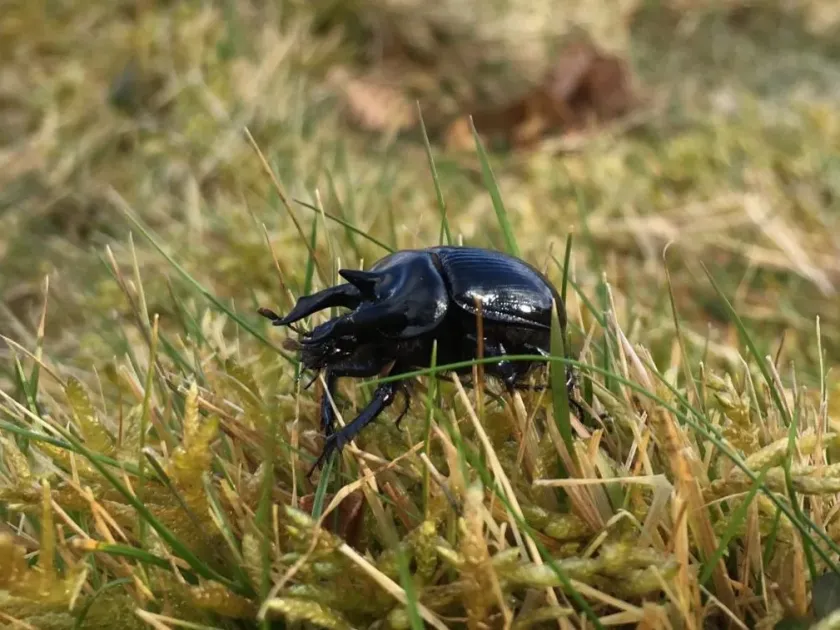
The Minotaur beetle (Typhaeus typhoeus) is a species of dung beetle belonging to the family Scarabaeidae. These beetles are easily identified by their glossy black bodies, which typically measure between 15 and 25 mm in length.
The most striking feature of the male Minotaur beetle is the presence of three long, forward-pointing horns on the pronotum, which give it a unique appearance. Females lack these large horns, having only minor ridges instead.
These insects are specialized coprophages, meaning they feed on the dung of herbivores. They are equipped with powerful, shovel-like front legs designed for excavating deep tunnels in the soil.
The larvae are typically C-shaped, typical for the scarab family, and develop underground. They rely on the dung supplies stored by their parents within vertical soil burrows.
Minotaur beetles are commonly found in open habitats, including pastures, meadows, and heathlands, where sandy or light soil allows for easier burrowing.
What it damages
The Minotaur beetle is generally not considered an agricultural pest. It does not feed on crops, vegetables, or commercial plant foliage, making it harmless to most farm operations.
Their ecological impact is primarily beneficial, as they contribute to the rapid decomposition of manure and increase soil aeration through their tunnel-digging activities.
In very rare cases, extremely high populations in localized pasture areas might cause slight damage to turf integrity due to the sheer volume of underground excavation.
However, this activity is minor and does not result in significant economic loss for farmers. The benefits of improved nutrient cycling usually far outweigh any minor physical disturbance to the soil.
In industrial agriculture, there are no specific threshold levels set for this beetle because it does not compromise crop yields or quality.
When it appears
Adult Minotaur beetles are most active during the autumn and spring months in temperate climates. They are well-adapted to cooler conditions, allowing them to remain active when other species hibernate.
Adults typically spend the winter months inside their deep tunnels, which protect them from freezing temperatures and predators, though they may emerge on warmer winter days.
The life cycle is quite prolonged. Females create vertical tunnels under dung piles, where they pack chambers with manure to serve as food for the developing larvae.
Larval development takes a significant amount of time underground, where they progress through several instars before pupation occurs within a special soil-dung cell.
New adults usually emerge towards the end of summer or in autumn, beginning the cycle once more as they seek mates and fresh food sources.
Control measures
As the Minotaur beetle is not an agricultural pest, no control measures are necessary. Their presence is a sign of a healthy ecosystem with sufficient organic matter turnover.
If their tunneling activity becomes undesirable in specific areas like sports fields or manicured lawns, the best approach is to improve drainage and keep the turf dense to discourage excavation.
Pasture management practices, such as routine harrowing to break up manure, can indirectly reduce the population density by limiting the resources available for larval development.
The use of insecticides is strongly discouraged as it causes unintended harm to the local soil ecology and eliminates beneficial insect populations that provide free soil maintenance services.
- Maintenance of dense, healthy turf.
- Routine pasture harrowing.
- Limiting excessive manure concentration in sensitive areas.
Taxonomy
- Latin name
- Typhaeus
- Order
- Coleoptera (beetles)
- Family
- Geotrupidae
- EPPO code
- TYHSSP
Discussion
No discussions yet — be the first.