
Common dor beetle
Geotrupes stercorarius
Description
How to identify
The common dor beetle, scientifically known as Geotrupes stercorarius, belongs to the family Geotrupidae within the order Coleoptera.
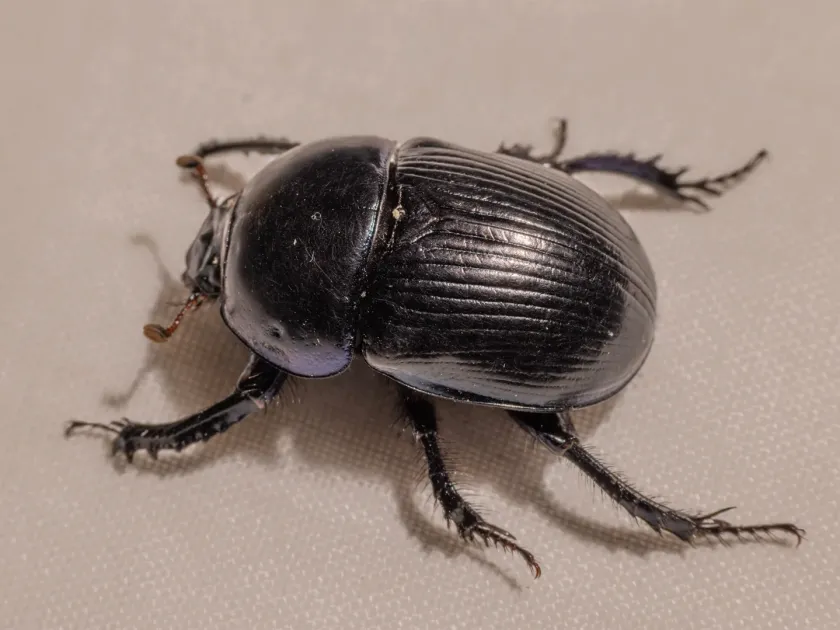
Adult beetles are large, typically ranging from 15 to 27 millimeters in length, with a distinct, oval-shaped and highly convex body structure.
Their coloration is glossy, ranging from metallic black to dark blue or violet, with a bright metallic sheen on the underside of the body and legs.
The elytra are marked by clear longitudinal striae, and the head and pronotum have a smooth surface with minimal, sparse punctation.
Larvae have a typical scarabaeiform shape: soft, white, C-shaped bodies with brown heads, residing deep within underground soil burrows.
What it damages
While the common dor beetle is generally considered beneficial for decomposition, it can occasionally act as a nuisance pest in managed agricultural settings.
Direct damage occurs when adult beetles excavate deep burrows near the base of young plants, physically disturbing the root systems and leading to stress or wilting.
In pastures, their digging activity can disrupt the uniformity of the sod, leading to soil structural changes that may interfere with forage crop growth.
While they primarily feed on dung, their habit of packing organic matter deep into tunnels can cause localized root damage in sensitive vegetable or ornamental crops.
Economic damage is usually minimal, but in high densities, they can weaken vulnerable saplings, requiring mitigation strategies to protect the planting.
When it appears
The common dor beetle is primarily active from late spring through the summer months, aligning with the peak availability of dung and warm weather.
Adults emerge from their hibernation sites early in the season and begin their reproductive phase, which involves building complex tunnel systems.
By autumn, adult activity diminishes significantly as beetles retreat deeper into the soil to prepare for overwintering in secure, underground chambers.
The life cycle is long and often lasts a full year, encompassing the egg, larval, pupal, and adult stages, with most development occurring underground.
Adults are often spotted flying at dusk or during warm, humid weather, which stimulates their search for nesting sites and food resources.
Signs of infestation
The presence of common dor beetles is easily identifiable by the small, circular mounds of soil pushed to the surface near tunnel entrances.
Holes of approximately 10 to 15 millimeters in diameter in the soil, often located near manure piles or composting areas, are definitive indicators of their presence.
Wilting of young plants without clear signs of fungal pathogens or insect feeding on leaves often suggests damage to the root system beneath the surface.
Rapid disappearance of fresh organic manure on the soil surface is a clear sign that dor beetles are active and hauling the material underground.
- Circular tunnel entrances in the soil.
- Small mounds of excavated soil.
- Sudden wilting of young crops.
- Observation of metallic-blue or black beetles during dusk.
- Loss of organic matter from the soil surface.
Control measures
Deep cultivation of the soil during spring and autumn is the most effective method to destroy nesting tunnels and reduce the local beetle population.
Avoid applying fresh, uncomposted manure directly around the root zone of susceptible young plants to prevent attracting beetles during their peak activity.
Maintaining a clean cultivation area and removing unnecessary piles of decaying organic matter helps to discourage dor beetles from nesting nearby.
Using well-decomposed compost reduces the attractiveness of the site to the beetles, as they prefer fresh dung for their larval food stores.
While chemical control is rarely justified, good agricultural practices and crop rotation are sufficient to manage any issues related to their digging activity.
Taxonomy
- Latin name
- Geotrupes stercorarius
- Order
- Coleoptera (beetles)
- Family
- Geotrupidae
- EPPO code
- GEOUSR
Discussion
No discussions yet — be the first.