
Iberian snail
Iberus alonensis
Description
How to identify
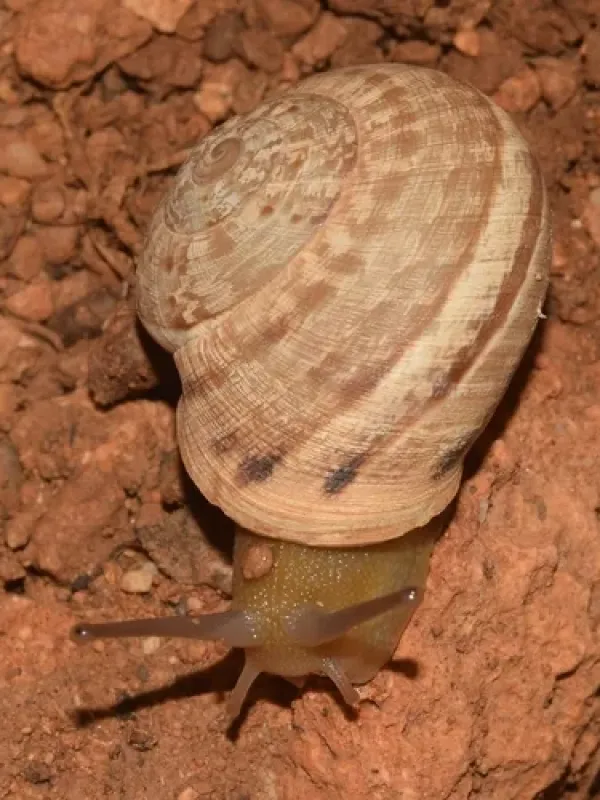
The Iberian snail (lat. Iberus alonensis) is a land-dwelling gastropod mollusk belonging to the family Helicidae and the order Stylommatophora. It is characterized by a globose shell with a low spire, typically white to yellowish-brown with dark banding.
Adult snails can reach diameters of 3 to 4 centimeters. Their soft body is covered in a protective mucus that prevents desiccation, allowing them to survive in drier environments compared to other common garden snails.
Native to Mediterranean landscapes, this species is well-adapted to rocky and arid terrains but thrives in agricultural settings where moisture and food are abundant.
Their biological cycle is heavily influenced by environmental conditions; they remain dormant during extreme heat and become active primarily during humid periods or at night.
Reproduction involves laying eggs in moist soil, which offers protection from the sun and environmental stress, ensuring a high survival rate for the next generation.
What it damages
The Iberian snail is a significant polyphagous pest capable of causing substantial damage to a variety of vegetable crops, ornamental plants, and fruit nurseries.
They feed on above-ground plant tissues, leaving irregular, large holes in leaves and stems, and often consuming young seedlings completely, which results in significant crop losses.
Fruit and vegetable quality is compromised, as feeding damage can occur on the edible parts of the plants, rendering them unmarketable for commercial sale.
Feeding wounds provide entry points for secondary bacterial and fungal pathogens, which can lead to further plant decay and systemic health issues in the affected crops.
In nurseries, they can strip the bark from young saplings, causing severe growth stunting or the eventual death of the affected trees if the infestation is severe.
When it appears
The peak activity period occurs during the spring and autumn months when temperature and humidity levels are favorable for the snail's metabolic activities.
During the dry summer season, the Iberian snail undergoes estivation, attaching itself to rocks, tree trunks, or hiding in soil crevices to reduce water loss until conditions improve.
Increased activity is consistently observed following rainfall or after intensive irrigation, as snails emerge from their refuges to forage for food.
Autumn is the critical window for mating and egg-laying, ensuring that the population is well-positioned for the upcoming season after passing the winter in a protected state.
Winter survival is achieved by remaining dormant in the soil or under dense organic debris, protecting them from freezing temperatures and unfavorable weather.
Signs of infestation
The primary sign of infestation is the presence of large, irregular holes in the foliage of host plants, often occurring overnight due to their nocturnal habits.
Shiny, silver-colored mucus trails are frequently found on the leaves and soil surface, serving as a clear indicator of snail activity in the area.
During morning inspections, snails can often be found resting in cool, shaded areas near the base of the plants or beneath large leaves.
Excrement droppings on the soil surface near feeding sites are another common diagnostic feature for assessing the presence of these mollusks.
Flashlight surveys at night remain the most accurate way to detect and assess the severity of an infestation in vegetable gardens or greenhouses.
Control measures
Cultural control methods are essential, including regular weeding, the removal of organic debris, and proper soil management to eliminate hiding spots for the snails.
Creating physical barriers using abrasive materials such as wood ash, crushed eggshells, or gravel around vulnerable plots can effectively discourage snail movement.
The use of molluscicides, particularly those containing iron phosphate, provides a targeted and relatively environmentally friendly option for managing larger infestations.
Manual collection in the evening or the use of fermented bait traps (e.g., beer traps) are effective strategies for small-scale gardens or controlled environments.
- Adjusting irrigation to direct water only to the roots to keep soil surfaces drier.
- Encouraging natural predators such as hedgehogs, ground beetles, and birds.
- Using copper-based barriers to deter the movement of snails into specific beds.
Taxonomy
- Latin name
- Iberus alonensis
- Order
- Molluscs
- Family
- Helicidae
- EPPO code
- IBERAL
Discussion
No discussions yet — be the first.