
Spanish slug
Iberus
Description
How to identify
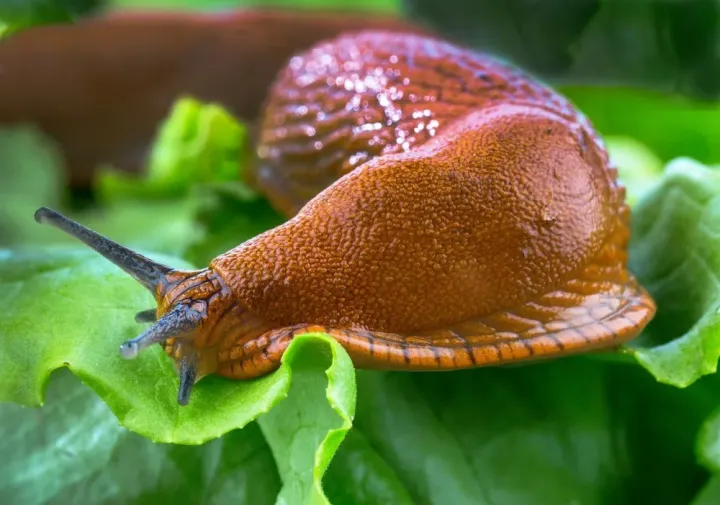
The Spanish slug (Arion vulgaris, often misidentified with the genus Iberus) is a large invasive gastropod mollusc, reaching lengths of 7–15 cm. Its body ranges in color from reddish-brown to orange, and its surface is covered with thick, sticky mucus.
A key identification feature is the absence of a shell and the presence of a breathing hole located in the anterior part of the mantle. Unlike local native species, this pest possesses high fertility and resilience to unfavorable climatic conditions.
This species belongs to the family Arionidae, order Stylommatophora. It is a hermaphrodite, which allows each individual to lay up to 400 eggs per season, ensuring rapid spread and population growth in new areas.
Adults are active mainly at dusk and night, as well as during wet weather. During the day, they hide in shaded places under plant debris, stones, boards, or thick mulch, where high humidity is maintained.
The slug's body is highly elastic, allowing it to penetrate narrow cracks and cavities inaccessible to other pests. Its epidermis contains specific glands that produce abundant mucus, which protects it from dehydration and makes it practically unpalatable to most birds.
What it damages
The Spanish slug is a polyphage and causes catastrophic damage to almost all types of agricultural crops. Vegetables, including cabbage, lettuce, potatoes, tomatoes, and cucumbers, as well as ornamental flowering plants, are at high risk.
The pest does not limit itself to the aerial parts of plants; it readily eats root crops, chewing deep tunnels inside them. It also damages young seedlings, seeds, strawberries, and raspberries, completely destroying the marketability of the produce.
A major risk is damage to fruit lying on the soil, as pathogenic fungi and bacteria enter through the chewed holes, causing the crop to rot. This leads to product loss not only in the field but also during storage.
In gardens and parks, slugs eat the leaves of ornamental plants, leaving behind unsightly skeletonized remains. A mass infestation can destroy a significant portion of crops on a plot or farm in a short period.
In addition to eating tissues, slugs contaminate plants with feces and mucus, making them unsuitable for sale or human consumption. High population density can lead to the total destruction of seedlings in early growth stages.
When it appears
The activity of the Spanish slug begins in early spring as soon as soil temperatures exceed +5...+7°C. During this period, the pests emerge from hibernation sites and begin feeding actively on young shoots.
The population peak usually occurs in the wet summer, when temperature conditions favor reproduction and juvenile development. In July and August, the highest number of individuals reaching sexual maturity is observed.
Egg-laying occurs in late summer and autumn. Eggs are laid in the soil or under plant debris, where they successfully overwinter, possessing high cold tolerance, which allows the species to successfully colonize temperate latitudes.
In dry and hot weather, mollusc activity temporarily decreases; they move deeper into the soil or under shelters to wait out moisture deficits. However, with the first rain or irrigation, their activity resumes with renewed vigor.
The total development cycle takes one year, but under favorable conditions and sufficient food availability, the pests can develop continuously until stable frosts occur. Mortality of juveniles during winter is extremely low.
Signs of infestation
The first and most obvious sign of the Spanish slug's presence is the shiny, silvery trails of dried mucus on leaves, stems, and paths around beds. This is a reliable marker of the pest's activity at night.
Holes of irregular shape with jagged edges appear on vegetable leaves. In severe cases, only large veins remain of the leaves, which indicates a high population density on the site.
When inspecting root crops such as carrots or potatoes, deep cavities often filled with mucus can be found. Similar damage is seen in berry crops, where slugs eat the pulp, leaving hollows.
The presence of a large number of individuals is easily confirmed by a night inspection of the site with a flashlight. Slugs congregate en masse in areas with high humidity, under mulch, boards, piles of plant debris, and near compost heaps.
Another characteristic sign is damage at the soil level, where pests chew through the stems of young plants at the base. This leads to rapid wilting and death of the entire plant within a few days.
Control measures
Controlling the Spanish slug requires a complex approach combining agrotechnical, mechanical, and chemical methods. It is important to begin prevention in early spring to prevent the reproduction of the first generation.
- Regular removal of plant debris and trash where pests find shelter.
- Creating barriers made of gravel, eggshells, or wood ash around beds.
- Manual collection of individuals at night or setting up traps (beer or kvass).
- Use of biological agents, for example, the nematode Phasmarhabditis hermaphrodita.
- Application of approved molluscicides based on iron phosphate.
Mechanical collection is most effective on small plots. Collected slugs must be destroyed in a salt or soapy solution, as simply throwing them over a fence does not solve the problem due to their high mobility.
It is important to keep surrounding areas clean, as weed-choked roadsides and abandoned neighboring plots often become reservoirs for the pest's migration to cultivated land. Regular mowing of grass around the garden significantly reduces the area's attractiveness.
Chemical preparations in granular form (molluscicides) should be applied strictly according to instructions, trying to minimize their contact with plant parts intended for food. The use of iron phosphate is considered the safest method for pets and birds.
Taxonomy
- Latin name
- Iberus
- Order
- Molluscs
- Family
- Helicidae
- EPPO code
- IBERSP
Discussion
No discussions yet — be the first.